I spent 8 months trying almost every online business model before I found affiliate marketing. Dropshipping, Amazon KDP, Etsy, print on demand, digital products — I went through all of it. Each one had a hurdle, Money to start, or a skill I didn’t have, or a setup so complicated I’d spend weeks just figuring out where to start.
Affiliate marketing looked different. No inventory. No product creation. No customer support. Just make content, add a link, someone buys, you earn a commission. Simple enough to actually start.
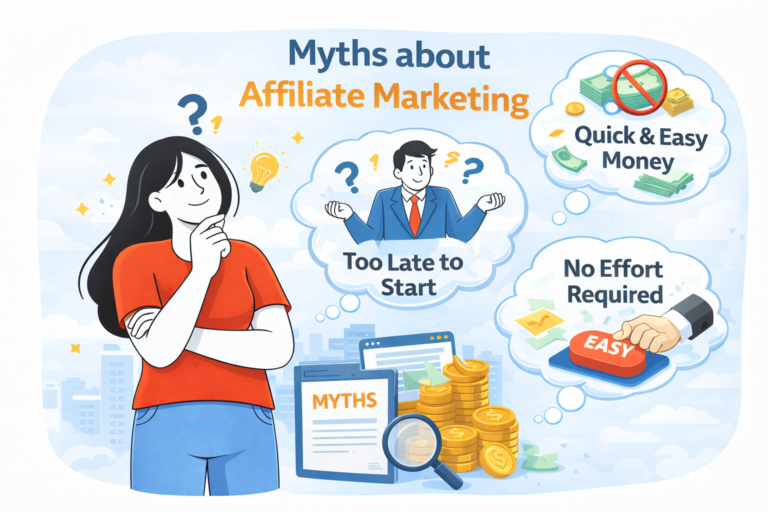
Except — once I got deeper into researching this — I realized that the version most people describe online is outdated. The ‘just put links in your content and wait for the money’ this approach stopped working the way people say it work. In 2026, affiliate marketing still works. But the way you have to do it has changed.
I went through dozens of case studies, income reports, and strategy breakdowns to understand what actually works now — especially for someone starting from zero with no existing audience, I have made this guide to answer all the doubts a beginners can have.
What is affiliate marketing in India?
Affiliate marketing is when you recommend a product or service to your audience, and earn a commission when someone buys through your unique link. You don’t own the product, handle any orders, or deal with customers — your only job is to connect the right person to the right product at the right time.
What is affiliate marketing and how does it actually work?
Affiliate marketing has three people involved — a company with a product, you (the affiliate), and the customer who buys it.
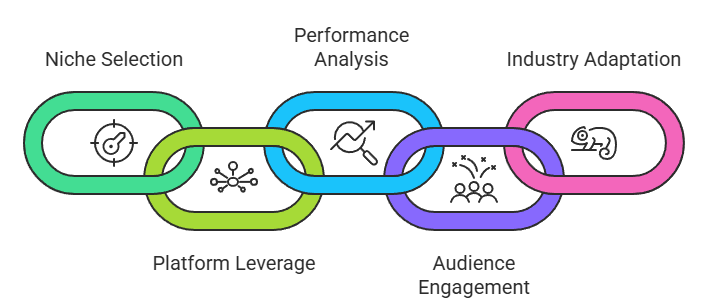
Your job is to be the bridge.
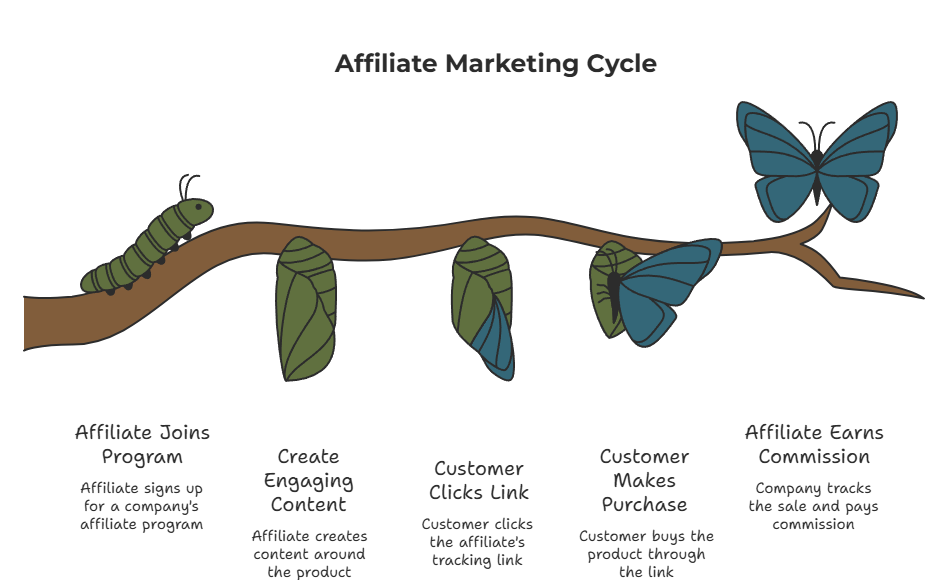
You join a company’s affiliate program, get a unique tracking link, and create content around that product. When someone clicks your link and buys — the company knows the sale came from you. You earn a commission. That’s the whole cycle.
You’re not just passing a link around. You’re finding the right audience, building their trust, and helping them make a decision.
The company pays you after the result happens — not before. Nobody loses anything upfront.
But here’s what most people don’t tell you when they explain this model.
The Theory is simple but the execution is not.
To actually get a sale, you need:
- Content that ranks or gets discovered
- An audience that trusts your recommendation
- Enough consistency to stick around while that trust builds
- The patience to keep going when nothing seems to be working
That last one is where most people quit. Results don’t show up in week two. They don’t always show up in month two either. From everything I’ve researched, the people who start seeing real traction are usually 7 to 8 months in — sometimes more.
The model doesn’t require upfront money. But it does require upfront time, effort, and patience. That’s the real cost of starting.
Is affiliate marketing in India actually worth it in 2026?
Short answer — yes. But let me explain why that question itself is worth looking at.
Think about it this way. Is education saturated? Is the job market saturated? Is business saturated? Everything that works has competition. That’s not a warning sign — that’s proof that people are doing it and getting results. If nobody was making money from affiliate marketing, nobody would be doing it.
The competition exists because the model works. That’s the only reason.
What has changed in 2026 is not whether it works or not — it’s how you have to do it. The global affiliate marketing industry is projected to exceed $20 billion in 2026, growing at over 15% annually. That’s not a dying industry. That’s an expanding one.
But here’s what the data also shows — and this part most people skip over:
- Most affiliates take between 6 and 12 months to see meaningful income
- Most people who start an affiliate marketing blog fail within the first year — not because the market is saturated, but because they treat it like a casual hobby instead of a real business
- Generic content with affiliate links scattered everywhere is dying. What is growing is deep, experience-based content where the creator has actually spent time understanding the product
So the old way — pick 10 random products, throw links into content, wait for money — that version is dead.
The new way is simpler to understand but harder to actually do. Pick one niche. Build real authority in it (by creating all type of content which give complete knowledge about a niche). Create content that genuinely helps people make decisions. That is the formula. But it takes months of consistent work before you see anything move.
The people earning from affiliate marketing right now aren’t the ones who found a shortcut. They’re the ones who stayed.
How do you actually make money with affiliate marketing?
Someone finds your content. Trusts your recommendation. Clicks your link. Buys the product.
The company sees the sale came from you — and pays you a commission.
That’s the flow. Simple on paper, but here’s what actually has to line up before that commission happens:
- You need traffic coming to your content
- That traffic needs to trust you enough to click
- The product needs to match what they were already looking for
- The timing has to be right
Most beginners focus on the link. The real work is building the conditions that make someone want to click it.
Types of commissions you’ll come across:
- CPS (Cost Per Sale) — you earn a percentage when someone buys. Most common model.
- CPL (Cost Per Lead) — you get paid when someone signs up or fills a form, even without buying.
- Recurring — common in software and subscriptions. One referral keeps paying you every month they stay subscribed.
- High-ticket — higher priced products, bigger flat commission per sale. Harder to convert without a trusted audience.
Which one should a beginner focus on?
Honestly — none of them specifically. Not yet.
When you haven’t made a single sale, debating commission types is just a distraction. Your only goal at this stage is to validate that you can convert at all.
Pick one program. Create content. See if people click and buy.
Once that’s working — even a little — then you have real data to decide. Recurring is worth chasing later because one referral pays you month after month. But you can’t optimise what you haven’t started.
What about the timeline?
- First 2–3 months — little to no traffic, feels like nothing is working
- Month 4–6 — you start understanding what content is getting traction
- Month 7–8 — small results start showing up
- Beyond that — things start compounding if you haven’t quit
The income doesn’t feel passive at the start. It becomes passive after months of very active, consistent work.
Which affiliate programs should a beginner start with?
Before picking a program, pick a niche. The program follows the niche — not the other way around.
The biggest mistake beginners make is chasing the highest commission first. They end up promoting random products across five different topics, building trust in none of them.
First — understand the two types:
Direct programs — you sign up with one specific brand. Example: Amazon Associates, Hostinger, Booking.com.
Affiliate networks — one platform that houses hundreds of brands. You join once and access all of them.
- Amazon Associates — works for almost every niche. Low commissions (1–10%) but high conversion rates.
- ShareASale — thousands of brands across lifestyle, fashion, home, health. Beginner-friendly.
- CJ Affiliate — bigger brands like Expedia, GoPro. Better for tech and travel niches.
- ClickBank — best for digital products. High commissions in fitness, health, online learning.
- Impact & PartnerStack — advanced networks. Better suited once you have consistent traffic.
Programs by niche:
| Niche | Programs to explore | Commission range |
|---|---|---|
| Tech / Software | Amazon, PartnerStack, Hostinger | 4–40%+ |
| Beauty & Skincare | Sephora, ShareASale brands | 5–10% |
| Travel | Booking.com, Expedia, Travelpayouts | 4–50% |
| Health & Fitness | ClickBank, iHerb, Myprotein | 5–15% |
| Food & Nutrition | Amazon, ShareASale brands | 8–40% |
| Education / Courses | Skillshare, Coursera, Digistore24 | 20–45% |
| Finance | CJ, niche finance brands | 20–50%+ |
| Hobbies & Photography | B&H Photo, ShareASale brands | 8–20% |
One-time vs recurring commission:
| POINTS | One-time | Recurring |
|---|---|---|
| When you earn | Once per sale | Every month customer stays |
| Best for | Physical products, courses | Software, subscriptions |
| Effort per rupee | Higher — need new sales constantly | Lower — one referral keeps paying |
| Beginner friendly | Yes — easier to find | Harder to convert early on |
Before joining any program — check these 4 things:
- Cookie duration — how many days after clicking your link can someone still buy and you get credit. Longer is better.
- Minimum payout — can a beginner realistically reach it in the first few months?
- Payment method — does it pay to Indian bank accounts or PayPal?
- Brand trust — would your audience actually buy from this brand?
The right program is the one that fits your niche and your audience. There is no universal best option — You have to search and see what’s working for you.
Do you need a Blog, YouTube channel, or Instagram to do affiliate marketing?
Short answer — you need a platform where your audience is actively looking for what you create. Which platform that is depends entirely on your niche.
In 2026, one platform alone is risky. Algorithm changes, account restrictions, sudden drops in reach — any of it can happen overnight and you have zero control over it. Diversifying your traffic protects your business from things outside your hands.
That said — don’t try to be everywhere at once. Pick two platforms. One primary, one supporting.
Reality check on each platform:
| Platform | Best niche fit | Reality check |
|---|---|---|
| Blog / Website | Any niche | Takes 6–12 months minimum to see organic traffic. Not a quick start. |
| YouTube | Tech, finance, beauty, fitness | Builds trust fast but needs consistent video output — most people underestimate this. |
| Beauty, fashion, lifestyle, food | Massive reach but no direct linking in posts — everything goes through bio link. | |
| Home, food, fashion, travel | Slower growth, works best as a supporting platform not a primary one. | |
| Broad, older audiences | Organic reach is declining — harder to grow without paid ads. |
The two platform approach — why it makes sense:
Most successful affiliate marketers aren’t running on one platform. They’re using one to create and one to distribute.
- One platform builds your long term searchable presence
- The second platform pushes that content to a wider audience faster
- Together they reduce your dependency on any single algorithm
Which two platforms you pick depends on your niche. There is no universal combination that works for everyone.
About Instagram specifically:
Instagram has the reach. But it has a structural problem for affiliate marketers — you can’t place clickable links directly in posts or reels. Everything goes through the bio. That one extra step between content and purchase quietly kills conversions.
Use it as a supporting platform to repurpose content. Don’t build your entire affiliate business on it.
How to find your right platform:
Don’t follow someone else’s platform choice. Research your own niche first:
- Search your topic on Google — is written content ranking?
- Search the same topic on YouTube — are there channels with real views?
- Check where your audience is asking questions — Reddit, Pinterest, Instagram?
The platform where your audience is already searching is where you start. Build something solid there first before adding a second one.
But if I tell you about stats-Video content is predicted to drive 55% of all affiliate traffic in 2026 and you have already seen it, if you want to buy something you would prefer watch a video before buying it.
But that doesn’t mean written content would be dead, it’s still getting 40% of commission and its evolving, and if you done it right you will see results in it.
What do you actually need to get started — the honest checklist?
Most people overthink the starting point. They wait until they have the perfect setup, the right tools, a big following, a proper laptop. None of that is actually required.
The real minimum to start affiliate marketing is a phone and an internet connection.
That’s it. If you have a laptop — great, it makes things easier. If you want a website — you’ll need to pay for a domain and hosting. But if you’re starting on YouTube, that’s completely free. The starting cost depends entirely on which platform you choose. The business model itself has no entry fee.
What you actually need — and what you don’t:
| What you need | What you don’t need |
|---|---|
| Phone or laptop | Expensive paid courses |
| Internet connection | Fancy tools or software |
| One niche | A huge following |
| One platform to start | Multiple platforms at once |
| Patience (7–8 months minimum) | A professional setup |
| Consistency | Anyone’s permission to start |
About paid courses:
Everything you need to learn is already on YouTube — for free.
The important thing is knowing who to learn from. Don’t follow people who switch niches every few months or talk more about lifestyle than actual strategy. Find creators who are actively doing affiliate marketing, showing their process, and being honest about what works and what doesn’t.
If you eventually want to invest in a course — only do it once you’ve started, tried things, and have specific questions a course can answer. Spending money before you’ve even started is just a way to feel productive without actually doing anything.
The mistake most beginners make before they even start:
They spend weeks getting ready — setting up the perfect website, researching 10 different tools, comparing every affiliate program. All of that is preparation disguised as progress.
The clarity you’re waiting for doesn’t come before you start. It comes after.
How long does affiliate marketing take to work?
Everyone asks this question and nobody gives an honest answer.
So here it is — it takes longer than what most people tell you. And that’s completely okay.
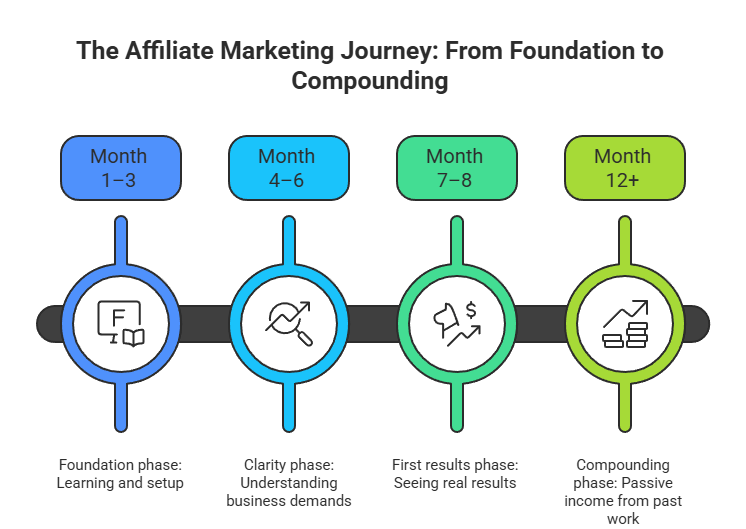
Month 1–3 — Foundation phase
- This is the phase where you are learning things and implementing them
- Setting everything up takes real effort in this period
- No traffic. No clicks. No commissions.
- This feels like nothing is happening — but this is where your entire foundation is being built
- Don’t measure this phase by results. Measure it by how consistent you are being
Month 4–6 — Clarity phase
- You start figuring out what this business actually demands from you
- You learn what you should do and what you should stop doing
- Small traffic starts coming in
- You might see your first click or your first sale somewhere in this phase
Month 7–8 — First results phase
- If you kept going consistently — this is where you start seeing something real
- Small results. But real ones.
- This is the phase most people never reach because they quit right before it
Month 12+ — Compounding phase
- The content you made in month 2 is still bringing you traffic
- Things start feeling passive — but only because of all the active work you did before
- This is what people show in income screenshots. They just never show the 12 months that came before it.
What happens mentally in those first few months:
Because there are no results but consistent effort is still needed — people get discouraged. And not just you. Everyone feels this way when they are putting in effort and seeing nothing come back.
You are not alone in this feeling. It is part of the process.
The people who keep working without obsessing over results — the ones who have faith in their efforts even when they feel exhausted and demotivated — those are the people who eventually win. They feel the same discouragement. They feel the same exhaustion. But they still keep going.
That is how you win in any business. Not just affiliate marketing.
Why do most people quit too early:
Because they were taught the wrong thing before they even started.
Someone told them — make content today, earn tomorrow. They were given the belief that results come in one to two months. And when they didn’t see any results like that — they think it is not working for them.
But that is not the reality. Any business model takes time and consistent effort to work.
So if someone is telling you that you will start making money in one to two months — they are either lying to you or trying to sell you a course.
What are the most common mistakes affiliate marketing beginners make?
Most people don’t fail at affiliate marketing because the model doesn’t work. They fail because of things they could have avoided if someone had told them honestly.
Here are the ones that actually matter:
Picking a niche for money not interest
You will be making content on this topic for months. If you don’t care about it you will quit before anything compounds. Pick something you know or are genuinely willing to learn.
Researching forever and never starting
Courses, videos, guides — and zero published content. Start with imperfect action. Make it better after. Waiting for perfect is just fear with a productive disguise.
Following one creator blindly
Learn from everyone. Take what makes sense, leave what doesn’t. No single creator has the complete answer for your specific situation. See what’s working across different people and make your own decisions.
Promoting too many products at once
More links does not mean more sales. Your audience gets confused and trust never builds. One niche, one audience, one or two products that actually fit.
Quitting before compounding starts
Most people quit in month two or three — right before things start moving. The slow phase is not a sign it’s not working. It is just the phase every single person goes through.
Frequently Asked Questions
Is affiliate marketing legal in India?
Yes — completely legal. You need a PAN card and a bank account to receive payments. That’s the bare minimum required.
Do I need GST registration to do affiliate marketing in India?
Not immediately. GST registration is only required if your annual income crosses ₹20 lakh — or ₹10 lakh if you’re from a special category state.
One exception — if you earn through an e-commerce platform, GST registration becomes mandatory regardless of your turnover. But when starting out and earning small commissions, you don’t need it. File your income tax return regardless — that applies to everyone.
Can I do affiliate marketing without a website?
Yes. Affiliate links can be shared through YouTube descriptions, link-in-bio pages, and social media. A website helps with long term SEO traffic — but it’s not a requirement to get started.
How much can a beginner realistically earn?
- Month 1–3: mostly zero
- Month 4–6: first clicks, possibly first sales
- Month 7–12: small but real income if you stayed consistent
- Month 12+: compounding starts
Anyone giving you a specific number for month one is either guessing or selling something.
Is affiliate marketing saturated in 2026?
Every field that works has competition. That’s not saturation — that’s proof it works. What’s gone is the shortcut version. Generic content with scattered links doesn’t work anymore. Authority in one niche, honest content, consistent effort — that still works.
Can I use AI to create affiliate marketing content?
Yes — but only as a starting point. AI can help you draft and structure. It cannot replace your real experience, your opinion, or your honest take on a product. That’s what makes content worth reading in 2026.
Where To Start
If you genuinely want to try and make money online — you have probably watched many videos on YouTube and seen many reels on Instagram about it. But real progress happens only when you start taking actions.
You can learn hundreds of things. But if you can’t implement — you will not see any results.
This is a business model. It needs three things from you:
- Patience — minimum 7 to 8 months even when results are not visible
- Problem solving skills — small problems will come and this happens in every type of business
- Consistent effort — even on the days when nothing seems to be working
If you can do these things — I can guarantee you that you will succeed.
You will learn a lot in this journey. And failure is just an illusion. You will not fail — you will learn and grow as you keep taking actions.
Start taking actions. That’s where everything begins.
You can also read How to Start Affiliate Marketing without money to get more clarity.