
I spent three weeks going through case studies, income reports, and documented creator journeys to understand what affiliate marketing for beginners actually looks like for someone starting from zero in 2026.
Not the pitch. The reality.
Here’s what kept coming up.
What Is Affiliate Marketing and How Does It Actually Work?
Most people understand the definition — the part they miss is how the money actually moves.
Four people are involved in every affiliate transaction. The merchant — the brand that created the product. The affiliate — you, promoting it through content. The consumer — the reader who clicks your link. And sometimes an affiliate network — a platform like ShareASale or Impact that handles tracking and payments between merchants and affiliates.
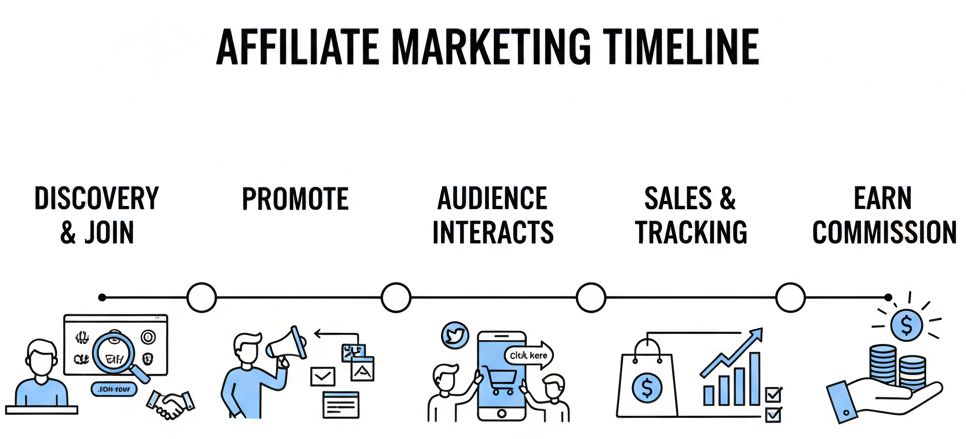
Your content is the bridge. You write a review, a comparison post, a tutorial — something that helps someone decide. They click your affiliate link. They buy. You earn a commission.
The tracking works through cookies. When someone clicks your link, a small file gets stored in their browser. If they buy within the cookie window — 24 hours on Amazon, 30–90 days on most other programs — you get credited, even if they come back a week later.
One thing beginners consistently miss: clicks don’t pay. Only purchases do — or sometimes leads, depending on the program. That distinction matters when estimating realistic affiliate income.
Affiliate Networks vs. Direct Programs — What’s the Difference?
| Points | Affiliate Networks | Direct Programs |
|---|---|---|
| What they are | Platforms housing hundreds of merchants (ShareASale, Impact, ClickBank) | Brand runs their own program in-house |
| Ease of joining | One application, access to many brands | Apply separately to each brand |
| Commission rates | Usually standard — network takes a cut | Often higher — no middleman |
| Best for | Beginners exploring options | Once you know your niche and audience |
For beginners, networks are the easier starting point. For long-term passive income, direct programs usually pay more.
Is Affiliate Marketing Still Worth Starting in 2026?
I’d honestly say yes — but not in the way it’s usually sold.
The argument you’ll hear: low startup cost, no product to create, passive income once content ranks. All true. What you won’t hear: it takes 6–12 months before most blogs or video content see meaningful traffic, and another few months before that converts into consistent commissions.
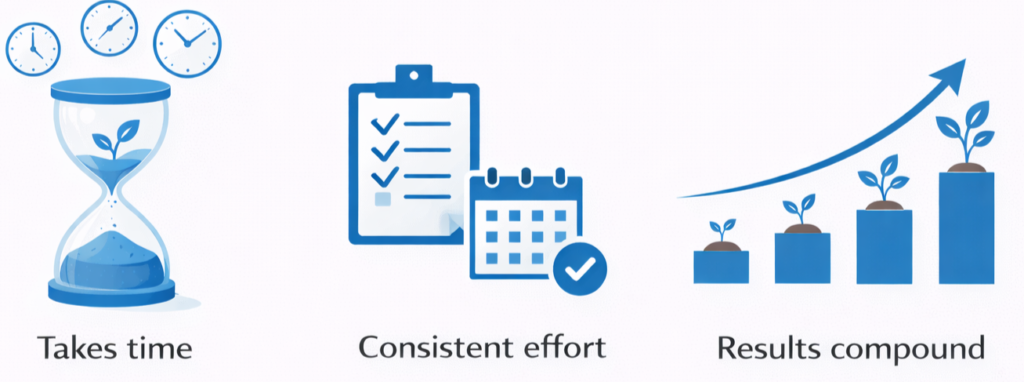
Adam Enfroy documented his journey from zero to $80,000/month in affiliate income — but he published 1–2 posts a week for two straight years with a digital marketing background. Pat Flynn’s Smart Passive Income generates significant recurring commission revenue, built over years of audience trust.
The model works. The timeline is just longer than most people expect.
What’s changed in 2026 is the search environment. Google’s AI Overviews now answer many informational queries directly in results — “what is affiliate marketing,” “how do cookies work,” basic how-to questions. Generic informational content gets fewer clicks than it used to.
What still earns affiliate income in 2026: comparison posts, honest product reviews with a real verdict, and content targeting buyers close to a decision — not just curious readers.
How Do You Choose a Niche That’s Actually Profitable?
This is where most beginners either go too broad or overthink it for months without starting.
A profitable niche sits at the intersection of three things.
First: interest you can sustain. Not passion — just something you’d read about on your own and not feel drained writing or making content about six months in. You’ll be researching this constantly.
Second: products with real commission potential. Some niches pay almost nothing — 0.5% on a $10 item is five cents per sale. Look for products over $50, programs paying 15%+, or SaaS tools with recurring commissions where you earn every month a customer stays subscribed.
Third — and this is the one people forget — buyers, not just learners. Someone typing “best project management tool for freelancers” is close to a purchase. Someone typing “what is project management” might never buy anything. High buyer intent keywords convert into affiliate income. High information intent mostly just brings traffic.
How Do You Test Whether a Niche Has Real Affiliate Potential?
Search “[niche] affiliate program” on Google. If 10+ programs come up with real commission rates, there’s money there.
Then search your potential post topics. If the first page is all Wirecutter, NerdWallet, or major media sites — you’ll need a specific angle to break through. “Best budgeting apps” is a wall. “Best budgeting apps for freelancers with irregular income” is a door — more specific, less competitive, and actually more useful.
What Are the Best Affiliate Programs for Beginners?
Most beginners spend too long comparing programs instead of just picking one and publishing content. Here’s what’s worth knowing.
Amazon Associates — easiest to join, every product category covered. Commissions are low (1–4%) but conversion rates are high. Good for physical products, not ideal for building significant affiliate income long-term.
ShareASale — been around since 2000, thousands of merchants across every niche. The first network worth joining for most beginners because of the sheer range.
Impact — more tech and SaaS-focused. Better programs if your niche involves software tools or online services.
ClickBank — digital products with commissions up to 50–75%. Quality varies a lot. If you’d be embarrassed recommending it to a friend, don’t promote it.
Direct programs — brands like Bluehost, ConvertKit, and Canva run their own affiliate programs at rates much higher than networks because there’s no middleman. Find them by searching “[product name] affiliate program” on Google.
Remember few platforms like Impact, they need to see proof that you are legit person doing this business so you must have a platform like You tube or Website and some piece of content so that you can show them and get approval.
What Should You Actually Check Before Joining?
A recurring 20% commission on a $50/month tool will earn you more over time than a one-time 30% on a $30 product — because you keep earning as long as the customer stays. That’s the math beginners miss.
Also check: cookie duration (30 days is standard — Amazon’s 24 hours hurts), payout threshold and method (some programs don’t pay internationally via PayPal), and whether the program approves new sites. Many on Impact and ShareASale reject applications from sites with no content. Get 5–10 posts published before applying to anything serious.
How Do You Build a Platform That Actually Gets Traffic?
A blog gives you the highest long-term leverage. Every post is a permanent asset that can rank and send commissions for years. The tradeoff: most blogs don’t see meaningful organic traffic for 6–12 months.
Pinterest moves faster than SEO for visual niches — home, food, finance, blogging. It’s a search engine with long shelf-life content. Anne from HerPaperRoute built significant early blog traffic from Pinterest before her posts ranked on Google.
YouTube builds trust faster than text. Honest reviews and tutorials convert well. Higher production effort, longer ramp-up before the algorithm distributes your videos.
Email is the one platform you actually own. Google can update its algorithm. Pinterest can cut your reach overnight. Your email list is unaffected. Most experienced affiliates treat email as the end goal — use content to get people onto a list, build the relationship there.
Blog vs. Social — Which Should Beginners Start With?
| Points | Blog (SEO) | Social (Pinterest / YouTube) |
|---|---|---|
| Time to first traffic | 6–12 months | 2–6 months |
| Traffic shelf life | Long — posts rank for years | Medium — pins last months, YouTube longer |
| Startup cost | ~$3–5/month hosting | Free |
| Best for | Long-term passive income | Faster early audience building |
| Biggest risk | Google algorithm changes | Platform algorithm changes |
Most beginners do best starting with a blog and adding Pinterest as a second source. Short-term traction while SEO compounds in the background.
How Do You Create Content That Actually Converts?
Content that earns affiliate commissions helps someone make a decision — it doesn’t just explain what something is.
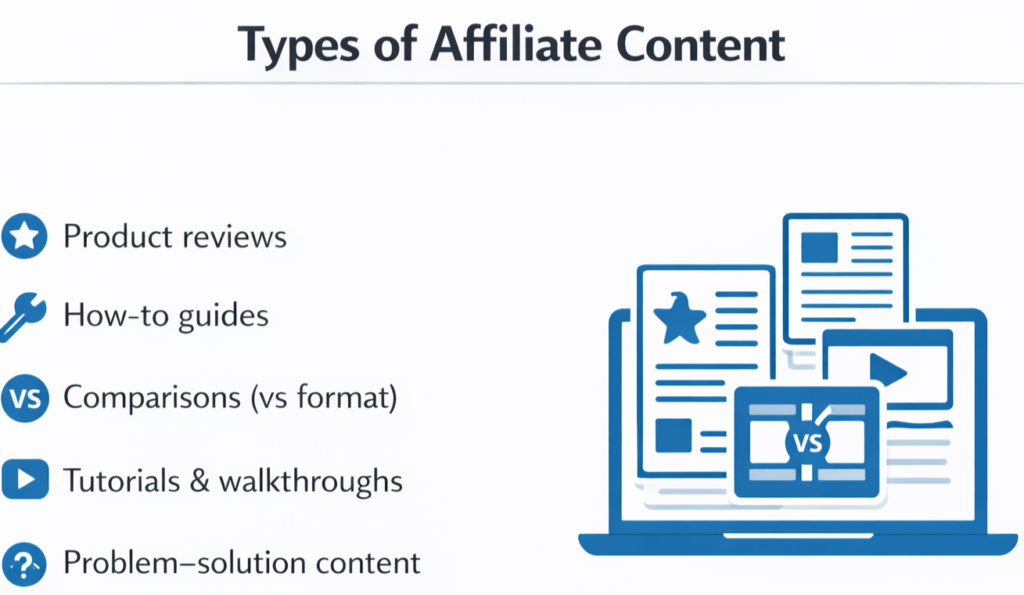
Comparison posts work because the reader has already decided to buy. “ConvertKit vs Mailchimp for bloggers” — that person is choosing, not researching. Give them the clearest, most honest answer.
Product reviews with a real verdict work when they have an actual opinion. Not a feature tour — that’s the product page. What’s genuinely good, what’s annoying, who it’s wrong for, what you’d recommend if the price is too high.
Specific best-of lists work. “Best email marketing tools for bloggers with under 1,000 subscribers” beats “Best email marketing tools” — easier to rank for, and the reader immediately knows you’re writing for them.
What Does a High-Converting Affiliate Post Look Like?
Skip the company history. Nobody searched your keyword to learn when the brand was founded.
- Quick answer first — verdict and who it’s for, in the opening paragraph
- Why this matters — two sentences confirming the reader is in the right place
- Detailed breakdown — features, real pricing, honest pros and cons
- Who it’s wrong for — this single section does more for your credibility than anything else
- Main alternative — a real decision, not just information
- FAQ — the three questions they’d Google right after reading
Bold the single most important sentence per section. Not decoratively — one thing per section only.
How Long Does It Take to Make Money With Affiliate Marketing?
The timelines you see online are usually too optimistic. Here’s what documented journeys actually show.
Months 1–3: You’re writing posts and getting indexed. Most people earn $0. That’s normal — every post is a long-term asset, it just doesn’t pay immediately.
Months 4–8: Traffic starts arriving on some posts. First commissions appear — usually small, a few dollars from Amazon or a single software referral. The mechanism is working even at small scale.
Months 9–18: Traffic compounds if you’ve been consistent. Some posts hit page one. Commissions become more regular. This is also when most people quit — right before things shift.
18 months+: Real recurring affiliate income becomes possible. How much depends on niche, volume, and whether you’ve built an email list alongside your content.
This part feels slow. That’s normal. Everyone hits this wall. The work feels invisible for months — you’re building search equity and audience trust. It just doesn’t show in your bank account yet.
What’s a Realistic Affiliate Income Expectation?
| Stage | Timeline | Realistic Monthly Income |
|---|---|---|
| Early | 0–4 months | $0–$50 |
| Building | 4–9 months | $50–$500 |
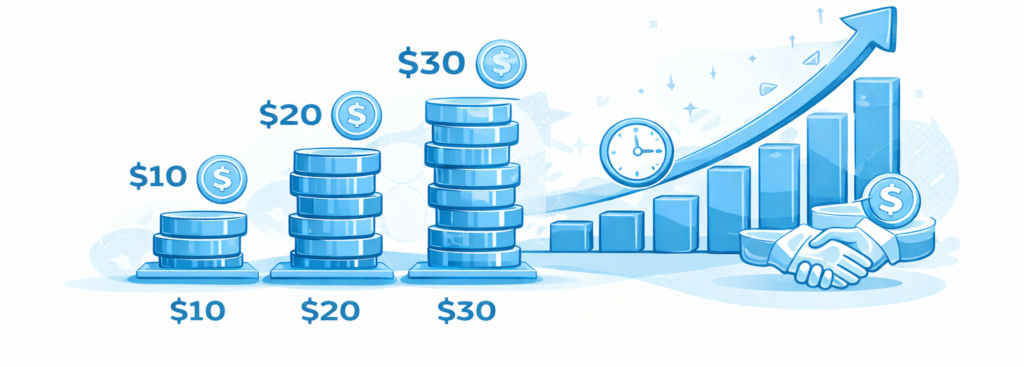
| Growing | 9–18 months | $500–$3,000 |
| Established | 18+ months | $3,000+ |
A blog in personal finance or SaaS reaches the higher end of these ranges faster than a low-commission niche — because each conversion is worth more, not because the traffic is higher.
What Mistakes Kill Most Beginner Affiliate Blogs?
I went through enough case studies and forum threads to see the same five patterns repeatedly in affiliate marketing for beginners.
Mistake 1: Targeting keywords that are too competitive
Writing “Best Laptops 2026” on a three-month-old site won’t rank. Wirecutter and Tom’s Guide have thousands of backlinks on that page. Start specific — “best laptops for architecture students under $1,000” — where a newer site can actually compete.
Mistake 2: Promoting too many products at once
When every post links to five different tools, readers sense the site exists to earn commissions, not help them. That instinct kills trust. Focus on a small number of products you’ve researched well enough to speak about with real specificity.
Mistake 3: Quitting at month four
Most affiliate blogs that failed stopped publishing between months 3 and 6. Right before traffic starts coming in. The timing is brutal and it’s not a coincidence.
Mistake 4: Skipping the email list
Traffic sources disappear. Google updates kill rankings. Pinterest cuts reach overnight. Your email list is the one asset no platform can take from you. Even 200 engaged subscribers is worth more than 5,000 one-time visitors.
Mistake 5: Writing or making content without a point of view
Neutral content doesn’t convert. People spending money want a trusted opinion. They want someone to say “I went through a dozen of these tools and this is the one I’d actually use.” That’s what makes someone click your link instead of bouncing back to Google.
Do You Need a Website to Start Affiliate Marketing?
Technically no — affiliate links can go in a YouTube description, Pinterest caption, or email newsletter.
But for sustainable long-term income, build a website. Social platforms can suspend your account or change their algorithm without warning. A website you own is the one piece of digital real estate that no platform can take from you.
WordPress is the standard. Bluehost and SiteGround both offer one-click installs at $3–5/month. A clean theme, your posts, and a visible affiliate disclosure is enough to start.
Affiliate link disclosure isn’t optional — the FTC in the US and ASA in the UK both require it. One line at the top of any post with affiliate links is enough: “This post contains affiliate links. I may earn a small commission at no extra cost to you.”
FAQ
Do I need to be an expert to start affiliate marketing?
No. You need the willingness to research more thoroughly than the average person and communicate honestly what you found. You can be upfront about being a learner — that’s often more credible than someone claiming expertise they don’t have. Never fabricate results or experience.
How much does it cost to start affiliate marketing?
Domain name: $10–15/year. WordPress hosting: $3–5/month. That’s the minimum. Write posts yourself without paid tools at the start. Keyword tools and email software can come later once you’re earning, or completely free if you use You Tube or other platform.
Can you do affiliate marketing without showing your face?
Yes. Plenty of successful affiliate blogs are completely faceless — the brand is the site, not the person. Written content, comparison tables, and Pinterest pins all work without video or photos of yourself.
Which affiliate network is easiest to get approved for?
Amazon Associates if you have any published content. ShareASale next — wide merchant selection, covers most niches, straightforward application. Don’t join five networks at once. Start with one, learn how it works, expand later.
How do you disclose affiliate links properly?
A short line at the top of any post with affiliate links: “This post contains affiliate links. I may earn a small commission at no extra cost to you.” Visible before the reader hits your first link — not buried in a footer.
Is affiliate marketing the same as dropshipping or MLM?
No. Affiliate marketing is earning a referral commission — no inventory, no shipping, no recruiting. Dropshipping means running your own store. MLM means recruiting a downline. Completely different models with different risk profiles.
What niche makes the most money in affiliate marketing?
Personal finance, SaaS, and web hosting pay the highest commissions because products are expensive and subscription-based. But they’re also the most competitive. A medium-commission niche where you can actually build authority will outperform a high-commission niche where you can’t rank. Choose based on what you can compete in — not just what pays the most on paper.
Where Should You Actually Start?
Pick a niche. Not the perfect one — just one you can research consistently where real affiliate products exist.
Pick your platform or Get WordPress running. Five published posts or content, it is enough to start applying to most programs.
Make content and write posts that help people decide, not just understand. Comparison posts and specific reviews move the needle faster than broad informational content early on.
Add more than one traffic source Pinterest for visual niches, YouTube if you’re comfortable on camera, pure SEO Google if you prefer writing and can wait out the timeline.
Then give it 90 days before deciding it’s not working.
The people who build real affiliate income aren’t the ones who planned most carefully. They’re the ones who published when the post wasn’t perfect and kept going past month four when nothing seemed to be happening.
Related: How Long Does It Take to Make Money With Affiliate Marketing?
Related: Best Free SEO Tools for Affiliate Marketing in 2026
Related: Affiliate Marketing Worth It in 2026? The Honest Truth