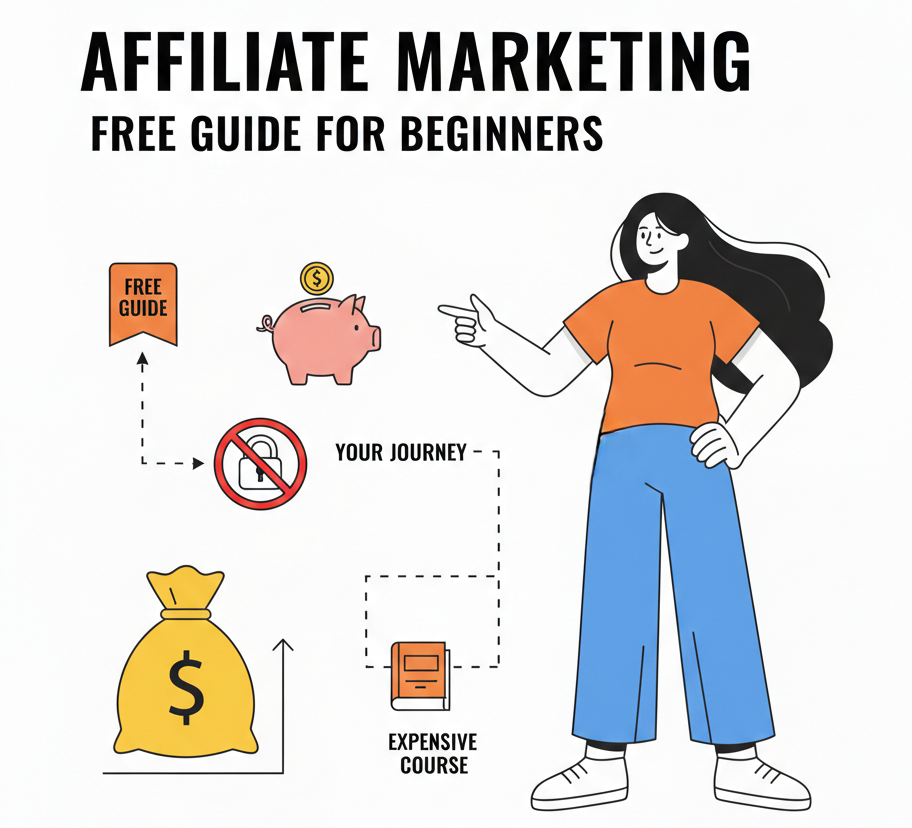
You’ve probably seen them. Those flashy ads promising you’ll make $10,000 a month if you just buy their $997 affiliate marketing course. But here you will learn how to start affiliate marketing without buying a course.
Here’s the truth: you don’t need to spend a single dollar on courses on to start affiliate marketing. Everything you need to learn is already free online. The real question isn’t whether you should buy a course—it’s whether you’re willing to figure things out yourself.
Look, I get why courses are tempting. They promise a shortcut. A proven system. A clear path from zero to hero. But here’s what nobody tells you: most people who buy courses never finish them. They pay, watch two videos, get overwhelmed, and quit.
This guide will show you exactly how to start affiliate marketing from scratch without spending money on education. I’m not saying courses are bad. I’m saying they’re not necessary. You can learn everything through free resources, trial and error, and actually doing the work.
Let’s be honest—you’re probably here because you’re tired of seeing “gurus” sell courses while claiming you need their course to succeed. The irony is thick, right?
What Affiliate Marketing Actually Is
Affiliate marketing is recommending products and getting paid when someone buys through your link.
That’s it. You don’t need to create products. You don’t handle shipping. You don’t deal with customer service. You find products other people made, share them with people who might want them, and earn a commission when they buy.
Think about it like this: remember when you told your friend about that great show on Netflix? Imagine if Netflix paid you $5 every time someone subscribed because of your recommendation. That’s affiliate marketing.
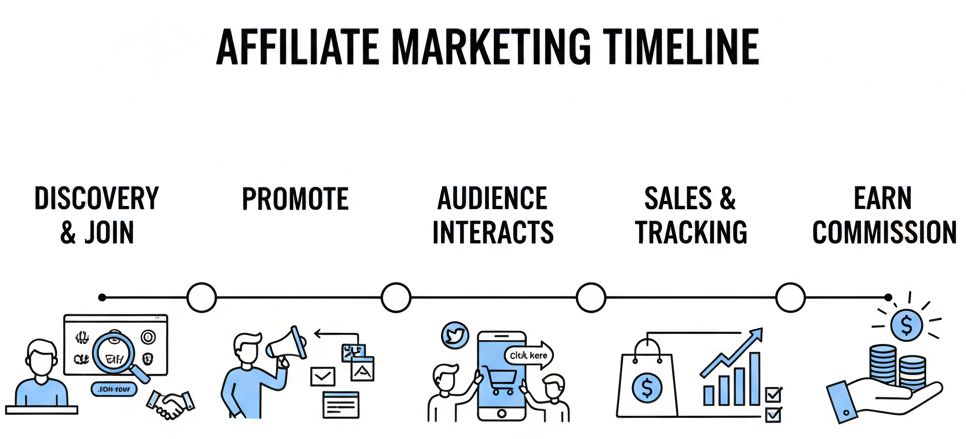
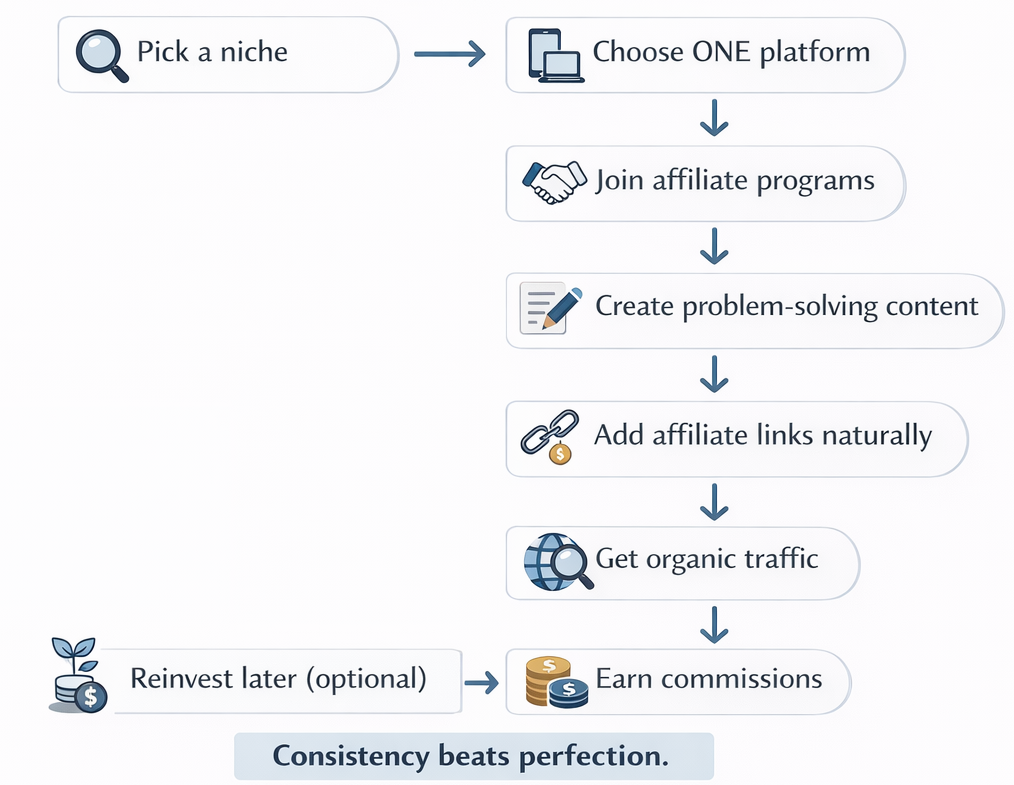
The basic process looks like this:
- You join an affiliate program (like Amazon Associates)
- They give you a special tracking link
- You share that link in your content
- Someone clicks your link and buys
- You get a percentage of the sale
Here’s what makes this different from other online businesses: You’re essentially a middleman, but in a good way. Companies want more customers. Customers want good recommendations. You connect them and get paid for it.
What You Actually Need to Get Started (Not Much)
Let me be real with you. You need three things to start affiliate marketing. Just three.
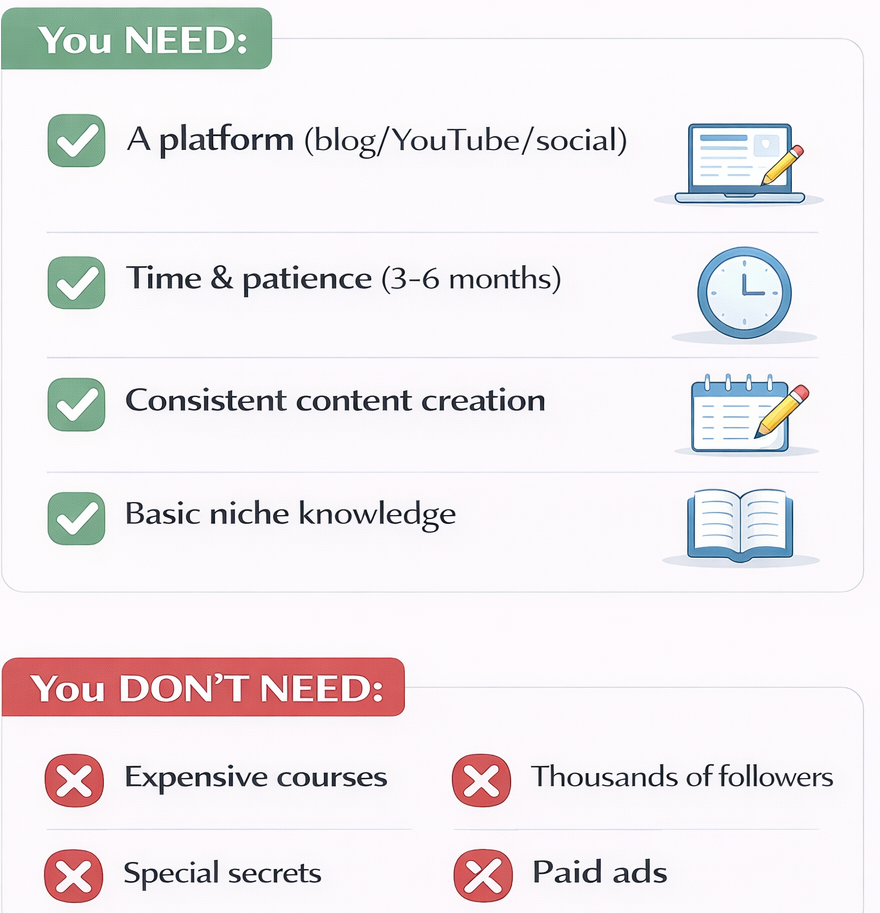
First, you need somewhere to share content. This could be a blog, YouTube channel, Instagram account, TikTok, or even email newsletter. Pick one platform where you’ll consistently show up.
Second, you need to join affiliate programs. These are free. Amazon Associates, ShareASale, CJ Affiliate, ClickBank—all free to join. No upfront costs.
Third, you need time and consistency. This isn’t money, but it’s what you’re investing instead. You’ll spend hours creating content before you see your first dollar.
Here’s what you don’t need:
- A fancy website (free options exist)
- Professional equipment (your phone works fine)
- Paid tools or software (start with free versions)
- A huge social media following (you can grow as you go)
- Thousands of dollars in startup capital
The real barrier isn’t money—it’s whether you’ll stick with it long enough to see results. Most people quit after a month. That’s why courses seem appealing. They feel like a commitment device.
Choosing Your Niche (Without Overthinking It)
Here’s where people get stuck for months. They research niches. They analyze competition. They make spreadsheets. Then they never actually start.
Let me simplify this. Pick a niche where these three things overlap:
- Something you know about or are willing to learn
- Something people actually buy online
- Something you won’t hate talking about for 6 months
You don’t need to be an expert. You need to be interested enough to create content consistently.
Common beginner-friendly niches include:
- Tech and gadgets
- Home and garden
- Health and fitness
- Personal finance
- Hobbies (gaming, photography, cooking)
- Pet care
- Beauty and skincare
Notice what’s not on that list? “Make money online.” Unless you have actual results to share, avoid the make-money niche. It’s oversaturated with people selling courses about courses.
Here’s the thing: your first niche probably won’t be your forever niche. And that’s okay. You’ll learn what works by doing, not by planning. Pick something reasonable and move forward.
Finding Affiliate Programs (The Free Way)
You don’t need someone’s course to find affiliate programs. They’re not hidden secrets.
Start with Amazon Associates. It’s the easiest program to get approved for. The commissions are low (like 1-4%), but Amazon sells everything. If you’re reviewing products, Amazon is your starting point.
Next, try ShareASale and CJ Affiliate. These are affiliate networks with thousands of programs. Sign up for free, browse their merchants, and apply to programs in your niche.
For digital products, check out ClickBank. The commissions are higher (often 50-75%) because there’s no physical product. But be careful—some products are scammy. Do your research before promoting anything.
Here’s my simple system for finding programs:
- Google “[your niche] + affiliate programs”
- Check if brands you already like have affiliate programs (most do)
- Look at what other creators in your niche are promoting
- Join 2-3 programs to start (don’t overwhelm yourself)
Don’t make this complicated. You need maybe 5-10 products to promote when you’re starting. That’s it. You can always add more later.
Many affiliate program like Impact or others reject beginners, The reason they reject new application is not because you don’t have followers or traffic but it’s to avoid spammy activity or bots. To avoid this situation I would suggest to first set up your platforms where you are sharing the content, Before joining the program, have few post to show that a real person behind this business that’s it.
If you got rejected don’t panic, simply email them Telling that “I am just starting this and wanted to join the program” [You can use chat GPT to write it] And by sending this email you would be accepted and you problem will be solved.
Creating Content That Actually Gets Clicks (No Fancy Skills Required)
Here’s what every course will teach you: create valuable content that helps people. That’s not wrong, but it’s vague.
Let me get specific. The content that makes money in affiliate marketing answers questions people are already asking. That’s it.
Types of content that work:
- Product reviews (“Is [product] worth it?”)
- Comparison posts (“[Product A] vs [Product B]”)
- How-to guides that mention products
- Best-of lists (“7 best [items] for [purpose]”)
- Problem-solving content (“How to fix [common issue]”)
You’re not trying to create viral content. You’re trying to create helpful content that shows up when someone searches for it.
Here’s what a simple review post looks like:
- Introduction explaining what the product is
- Who it’s for (and who it’s NOT for)
- Key features you actually tested
- Honest pros and cons
- Your recommendation with affiliate link
Use your phone to take photos. Write like you’re texting a friend. Don’t try to sound professional—try to sound helpful.
The mistake beginners make: they wait until they’re “good enough” to start. Your first 10 pieces of content will probably suck. That’s normal. You get better by doing it, not by studying it.
Where to Learn Everything for Free (Better Than Most Courses)
Want to know the dirty secret about affiliate marketing courses? Most of them just repackage free information and add some templates.
Here’s where to learn for free:
- YouTube: Search “[your niche] + affiliate marketing” and watch creators who actually show their results
- Blogs: Income School, Authority Hacker, and Smart Passive Income have years of free content
- Reddit: r/juststart and r/affiliatemarketing have real people sharing real experiences
- Free email courses: Many successful affiliates offer free email courses that are better than paid ones
My learning strategy when I started:
- Watched one YouTube tutorial per day while eating breakfast
- Read one blog post during my lunch break
- Actually implemented what I learned instead of consuming more content
- Joined free Facebook or Discord groups to ask questions
The real value of courses isn’t the information—it’s the structure and accountability. But you can create your own structure. Make a simple plan. Set a schedule. Tell someone what you’re doing so they check in on you.
Setting Up Without Spending Money
Let’s talk about the free tools that actually work.
For a website/Social media: Start with WordPress.com (free) or write on Medium. Don’t buy hosting and a domain until you’ve published 20 pieces of content. Prove to yourself you’ll stick with it first. If you don’t to do blogging you can skip this and do social media affiliate marketing by Just Posting content for free [this is more Beginner friendly option and you will see results fast by using social media]
For tracking: Google Analytics is free. Google Search Console is free. These show you what’s working and what’s not.
For keyword research: Use Google’s autocomplete. Type your topic and see what questions pop up. That’s free keyword research. Later, try Ubersuggest’s free tier.
For images: Unsplash and Pexels have free stock photos. Canva’s free version makes decent graphics. Your phone camera works for product shots.
For writing: Google Docs is free. Grammarly’s free version catches obvious mistakes. You don’t need fancy writing software.
Here’s the truth: fancy tools don’t make you money. Consistent content that answers real questions makes you money. I know people earning $3,000/month using only free tools.
What Actually Works (Based on Real Results, Not Hype)
SEO is your friend. Most beginners ignore it because it sounds technical. But SEO just means creating content people are searching for. Use real questions people ask. Answer them thoroughly. That’s SEO.
Comparison content converts best. When someone searches “[Product A] vs [Product B],” they’re ready to buy. They just need help deciding. If you can write 5-10 solid comparison posts, you’ll start seeing commissions.
Email builds long-term income. Every blog post should have a way for people to join your email list. Even if it’s just “Get my weekly recommendations.” Email subscribers buy more than random visitors.
Consistency beats perfection. Publishing one okay post per week beats publishing one perfect post per month. You learn faster. You rank faster. You earn faster.
Here’s a realistic timeline:
- Month 1-2: Learning and publishing, zero earnings
- Month 3-4: First few sales, maybe $20-50/month
- Month 5-6: Building momentum, $100-300/month
- Month 7-12: Growth phase, $300-1000/month
These numbers aren’t guaranteed. Some people take longer. Some go faster. But this is realistic for someone working 10-15 hours per week.
Common Beginner Mistakes (That Courses Won’t Always Tell You)
Mistake #1: Promoting everything. New affiliates join 20 programs and try to promote 100 products. Pick 5-10 products max when you start. Know them well. Promote them consistently.
Mistake #2: Hiding affiliate links. Don’t be weird about it. Say “I earn a commission if you buy through my link” and move on. People understand. Hiding it makes it worse.
Mistake #3: Only creating reviews. Review posts are good, but if that’s all you create, you’re limiting yourself. Mix in how-to guides, tutorials, and educational content that naturally mentions products.
Mistake #4: Quitting before Google or Algorithm notices you. It takes 3-6 months for Google to start ranking new content. Most people quit at month 2. They never see what could have happened.
Mistake #5: Buying traffic before mastering free traffic. Paid ads can work, but not when you’re learning. Master SEO and organic traffic first. Then consider paid traffic if you want to scale.
The biggest mistake: waiting for perfect knowledge before starting. You’ll learn more from publishing 10 imperfect posts than from watching 100 hours of tutorials.
What to Do When You’re Not Making Money (Yet)
Let’s be honest. The first few months suck. You’re working for free. Your content isn’t ranking. Nobody’s clicking your links.
This is the moment most people buy a course. They think, “Maybe I’m doing it wrong. Maybe there’s a secret I’m missing.” But here’s the reality: there’s no secret. There’s only patience and persistence.
If you’re three months in with zero earnings:
- Check if your content answers actual questions (search your topics on Google)
- Make sure your affiliate links work (click them yourself)
- Verify you’re in programs that pay reasonably well
- Look at your traffic—do you have any? If not, focus on SEO
- Ask yourself: am I actually publishing consistently?
The hard truth: most people fail at affiliate marketing because they quit too early, not because they’re doing it wrong. The information is out there for free. The work is the hard part.
Frequently Asked Questions
“How long until I make my first sale?”
Most people see their first sale in months 2-4. But it depends on your niche, content quality, and how often you publish. Don’t expect fast results.
“Can I do this without showing my face?”
Absolutely. Most affiliate websites are text-based blogs. No face required. You can be completely anonymous if you want.
“What if I pick the wrong niche?”
Then you learn, pivot, and try something else. Your first attempt is unlikely to be your biggest success. That’s normal. The fastest way to find the right niche is to try one and see what happens.
“Do I need to disclose affiliate links?”
Yes, legally you must disclose that you earn commissions. Just add a simple statement like “This post contains affiliate links, which means I earn a commission if you make a purchase.”
“How much can I realistically make?”
In your first year, $100-500/month is realistic if you’re consistent. Some people make more. Many make less. It’s not a get-rich-quick thing. It’s a build-gradually thing.
The Real Starting Point
Here’s what you should do today. Not tomorrow. Today.
Pick one platform. Blog, YouTube, Instagram—just one. Don’t try to be everywhere. Start where you’re most comfortable creating content.
Create your first piece of content. Don’t overthink it. Answer one question someone in your niche is asking. Include your affiliate link. Publish it.
Join two affiliate programs. Amazon Associates for physical products. One other program specific to your niche. That’s enough.
That’s it. You’ve started. You’re now further than 90% of people who think about affiliate marketing but never begin.
The truth about courses: They can’t make you do the work. Only you can. The information you need is free. What you’re paying for in a course is structure and motivation. If you can create your own structure and stay motivated through the slow months, you don’t need the course.
Start free. Stay consistent. Learn as you go. If you’re still stuck after six months of genuine effort, then maybe consider a course. But try the free path first. You might surprise yourself.
The barrier isn’t knowledge. It’s action. So what are you waiting for?