Unlock the secrets of affiliate marketing for beginners in 2026. Learn how to choose niches, find high-paying programs, build authority, and generate real passive income—step by step.
Introduction: Why 2026 is The Best Year of Affiliate Marketing for Beginners
Did you know that affiliate marketing spending in the United States is projected to reach $13 billion by 2026? That’s not just a dry statistic—it’s a massive, opportunity for anyone ready to tap into one of the most accessible online income streams available today.
I remember when I first heard about affiliate marketing. I was sitting on my bed, desperately googling “how to make money while sleeping.” It sounded like a scam, because many big influencers were saying this and honestly. Earning a commission just for recommending a product? It felt too good to be true. But after years of trial and error, I can tell you: it’s very real, but it’s no longer the “wild west” it used to be.
If you’ve been curious about making money online without the headache of creating your own products, handling grumpy customers, or managing a dusty warehouse of inventory, this is your golden ticket.
But here’s the cold, hard truth: the “spray and pray” method of 2015 is dead. In 2026, the landscape is dominated by AI-driven search engines and skeptical consumers. People don’t want a sales pitch; they want a trusted friend to guide them. This guide is designed to turn you into that trusted authority.
What Exactly Is Affiliate Marketing? (The 2026 Definition)
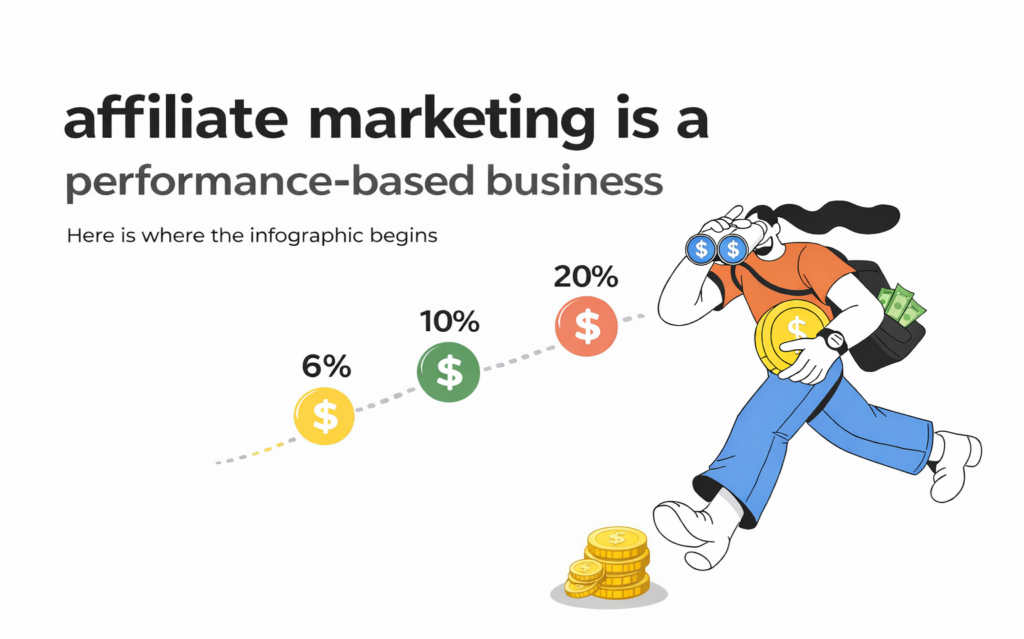
In its simplest form, affiliate marketing is a performance-based business where you (the affiliate) earn a commission for marketing another person’s or company’s products. You find a product you like, promote it to others, and earn a piece of the profit for each sale that you make. It is a win-win situation: the company gets a sale they wouldn’t have had otherwise, the customer finds a product that solves their problem, and you get a referral fee for your effort.
The Ecosystem: Four Moving Parts
To truly master this, you need to understand the relationship between the four key players:
- The Merchant (The Advertiser): This is the creator, seller, or brand. They could be a massive corporation like Amazon or a solo entrepreneur selling an ebook. They have the product; they just need more eyes on it.
- The Affiliate (The Publisher): That’s you! You are the engine of the operation. Your job is to provide value and context that makes a consumer want to buy. You act as the bridge between a problem and a solution.
- The Consumer (The Audience): These are real people with real problems. They are looking for a solution, whether it’s a better vacuum cleaner or a faster web host. They rely on your honesty to make a choice.
- The Affiliate Network: A platform that acts as a middleman, housing thousands of programs and handling the tracking and payments. They make it easy for beginners to find products without talking to brands directly.
The “Magic” Behind the Link: Tracking Cookies
How does a brand know you were the one who sent the customer? Through Affiliate Links. These links contain a unique ID. When a user clicks, a small file called a “cookie” is dropped into their browser. This digital tag tells the merchant exactly which affiliate deserves the credit for the sale, even if the customer doesn’t buy the product immediately but returns a few days later.
In 2026, cookie durations vary wildly. Some last 24 hours (like Amazon), while others last 60 or 90 days. If the user buys anything during that window, you get paid. It’s like leaving a digital breadcrumb that leads back to your bank account, ensuring you get rewarded for your marketing influence.
How Much Can You Actually Earn? (A Reality Check)
I hate those “gurus” who show off affiliate dashboard with unrealistic numbers and promise you’ll be a millionaire by Tuesday. Let’s look at what the journey actually looks like for a beginner starting today. Most people fail because they expect a payout in week one, but in reality, affiliate marketing is a compounding business where your efforts today pay off months down the line.
The Realistic Revenue Timeline
| Phase | Duration | Monthly Income | What You’re Actually Doing |
|---|---|---|---|
| The Grind | 0–3 Months | $0 – $100 | Finding your voice, setting up your blog, and shouting into the void. |
| The Spark | 4–8 Months | $100 – $1,000 | SEO starts kicking in. You get your first “commission earned” email. |
| The Momentum | 9–18 Months | $1,000 – $5,000 | You have a loyal audience. You’re optimizing old posts and testing high-ticket items. |
| The Pro | 18+ Months | $10,000+ | You’ve built a brand. Brands are reaching out to you for exclusive deals. |
The Secret Sauce: Engagement vs. Numbers Here is a human truth: I would rather have 500 loyal followers who trust my word than 50,000 random visitors who don’t know who I am. Engagement is the currency of 2026. Micro-influencers are crushing it right now because they feel “real” and approachable, whereas massive celebrities often feel disconnected from their audience’s everyday struggles.
Step 1: Choosing Your Niche (The Foundation of Everything)
This is the most critical decision of your journey. A niche is simply the specific topic or category you will focus on. If you choose a niche that is too broad, you will get lost in the noise; if you choose one that is too narrow, there won’t be enough people to buy. The goal is to find a “goldilocks” zone where you have enough expertise to be helpful [you don’t need to be an expert] and there is enough money circulating to make it worth your while.
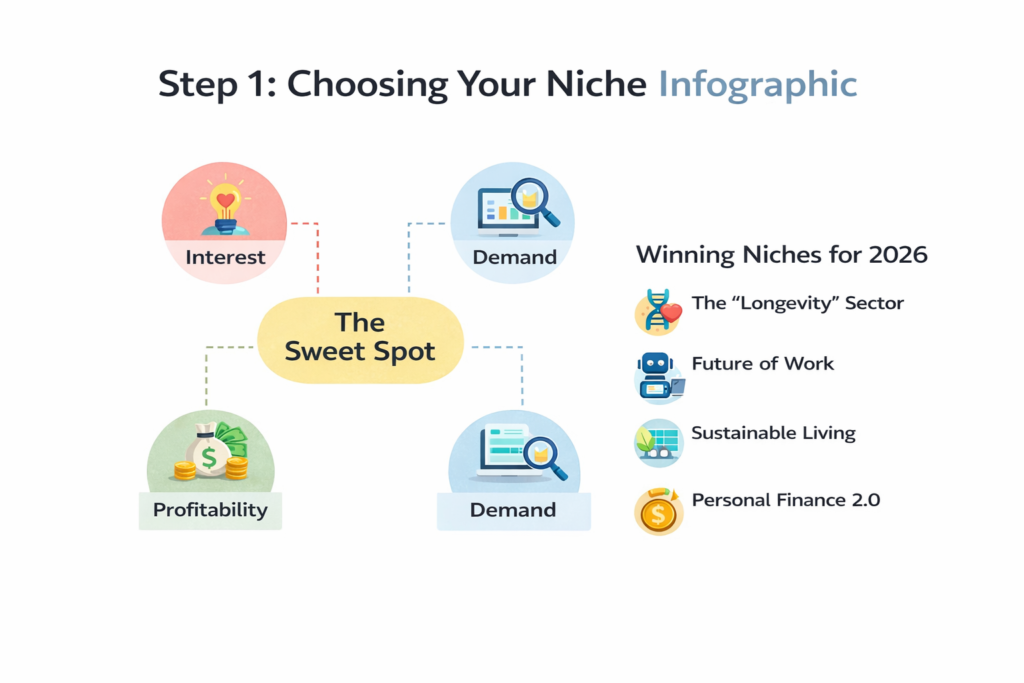
The “Sweet Spot” Formula
You need to find the intersection of three things:
- Interest: Something you could talk about for 30 minutes without a script. You’ll be writing about this daily, so pick something you genuinely care about.
- Profitability: Are there products to sell? Do they pay more than pennies? High-ticket items (over $500) or recurring subscriptions are the fastest way to hit your income goals.
- Demand: Are people actually searching for this? Use tools like Google Trends to ensure your topic isn’t a dying fad, but a growing or stable industry.
Reality Of Niche Selection
You don’t need to be an expert to choose a niche. What matters more is interest and willingness to learn.
If you pick a niche you’re genuinely curious about, you’ll naturally spend time researching, testing tools, and understanding the audience. Over time, that effort compounds — and you become knowledgeable through the process.
From my experience, niches fail less because of “low potential” and more because people quit too early or choose topics they don’t care enough to stick with. Consistency and learning matter more than starting expertise.
Look I don’t want to misguide you by saying “HERE ARE 10 MOST PROFITALBE NICHES”, there are few of them which are growing in 2026 and you can try it but from my experience:
There is no guaranteed “winning niche.” The success of a niche depends far more on where you promote your links and how well your content matches the audience on that platform.
A niche that fails on Google might perform extremely well on YouTube, Twitter, Reddit, or email — and vice versa. What matters is:
- Where your target audience already spends time
- What problems they are actively trying to solve there
- How clearly your content connects the product to that problem
Instead of chasing trends, choose a niche you can consistently create useful content for and pair it with the right traffic source. Distribution matters more than the niche itself.er. Instead, go for “Kettlebell training for desk workers over 40.” By narrowing your focus, you become the leading expert for a specific group of people, making it much easier to rank on Google and build a community of hyper-engaged fans.
Step 2: Finding and Joining the Best Affiliate Programs For Beginners
Once you have your niche, you need to find the companies that will pay you for your referrals. There are thousands of programs out there, ranging from giant retailers like Amazon to small software startups. For a beginner, the easiest way to start is by joining an “Affiliate Network” where you can browse multiple brands in one place, but eventually, you’ll want to find direct brand partnerships.
The Big Networks (The “One-Stop Shops”)
- Amazon Associates: The easiest to join. The conversion rates are insane because everyone has an Amazon account. It’s the perfect “training wheels” program for any new affiliate.
- ShareASale: A massive marketplace with thousands of merchants in every category imaginable. They have great reporting tools to help you track which links are making money.
- Impact.com: Very modern, great for finding high-end SaaS and tech brands. They offer a very user-friendly interface and direct messaging with brand managers.
- ClickBank: The king of digital products. High commissions (up to 75%), but you have to filter through some low-quality stuff to find the gems that truly help your audience.
In-House Programs (The “Hidden Gems”)
Many of the best programs aren’t on networks. These are “in-house” because the company manages them privately. Because they don’t have to pay a network fee, they often offer much higher commission rates and personalized support for their top-performing affiliates. You have to find them manually on Google or other platforms, if you know about your niche then you already have seen many companies or product brands which have there separate affiliate program you can contact them directly if you want to and promote there product to earn commissions.
What to Look For (The Checklist)
When I evaluate a program, I ask:
- What’s the Commission Rate? (Is it worth the effort of writing a 2,000-word review?)
- What’s the Payout Method? (Ensure they pay through a method accessible in your country, like PayPal or Wire.)
- Is it Recurring? (Recurring revenue is the key to true passive income—you do the work once and get paid every month the customer stays.)
- What’s the “Churn Rate”? (If customers cancel the service immediately, your recurring income disappears, so look for high-quality products people love.
Quick Note
Many affiliate networks (like Impact and similar platforms) often reject beginners who have no website, no content, or no proof of traffic. This isn’t personal — brands want to see where and how you’ll promote their links. Focus first on building one platform (blog, YouTube, social, or email) with real content. Approval becomes much easier once you show genuine activity and intent.
But don’t get me wrong there are many other affiliate programs which will accept you without any requirements , I just gave you a reality check that you don’t get discourage from rejection, just have a simple platform where you can promote links and you are ready to get approved by many but having some content in hand builds trust and authority.
Step 3: Building Your “Digital Real Estate” (Your Platform)
You need a place to put your affiliate links. While you can start on social media, you don’t actually own those accounts. If an algorithm changes, your business can vanish. Building a website or a newsletter gives you “Digital Real Estate” that you control, allowing you to build long-term value that can even be sold as a business later on.
1. The WordPress Blog (The Gold Standard)
A blog is your home base. It’s where you build SEO equity. When you rank for keywords like “best headphones for sleeping,” you are catching people at the exact moment they have their credit card in hand. This “search intent” is significantly more powerful than random scrolling on social media.
2. The YouTube Channel (The Trust Builder)
Video is the most powerful way to show, not just tell. Seeing you actually unbox, use, and test a product removes the “skepticism” barrier that text sometimes creates. In 2026, raw and honest video reviews are outperforming high-production commercials because they feel more authentic to the viewer.
3. The Email Newsletter (The Profit Maximizer)
An email list is the only traffic source you truly own. While Google or Facebook can cut off your traffic at any time, your email list is a direct line to your fans. By sending helpful tips and occasional recommendations, you can generate sales on demand without relying on an algorithm to show your post.
Don’t get confused you can start with one platform then you can expand, pick one which you like and which would work best according to your niche.
Step 4: Creating Content That Actually Converts
Content is the vehicle that carries your affiliate links. If your content is boring or feels like a “sales pitch,” people will click away. To succeed in 2026, your content needs to be deeply helpful. You aren’t selling; you are advising. Your goal is to provide so much value for free that the reader feels confident making a purchase through your link.
The “Anatomy” of a High-Converting Review
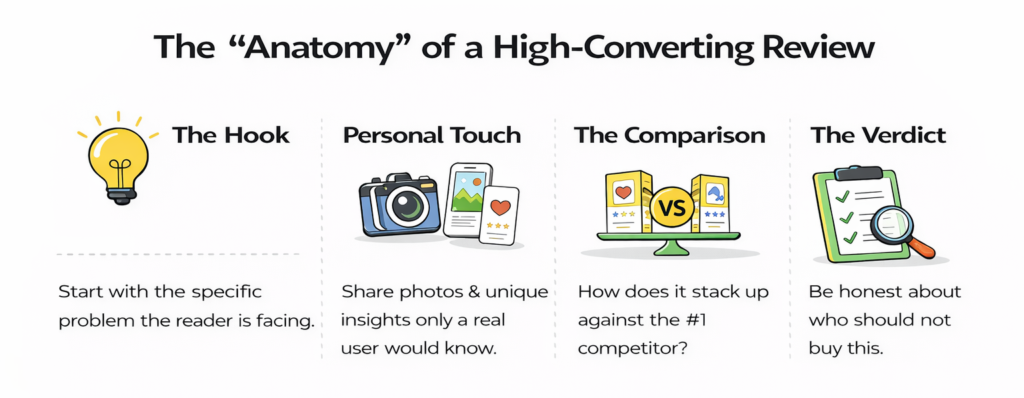
Don’t just list the features. People can read the manual for that. Instead:
- The Hook: Start with the specific problem the reader is facing.
- The “Personal Touch”: Show photos of you using it. Mention the small details that only a real user would know, like how a button feels or a common software glitch.
- The Comparison: How does it stack up against the #1 competitor? Providing an alternative shows you aren’t biased and actually care about the reader’s needs.
- The Verdict: Be honest about who should not buy this. If a product is too expensive for beginners, say so. This honesty builds massive trust and increases your long-term conversion rate.
Step 5: Driving Traffic (How to Get Eyes on Your Links)
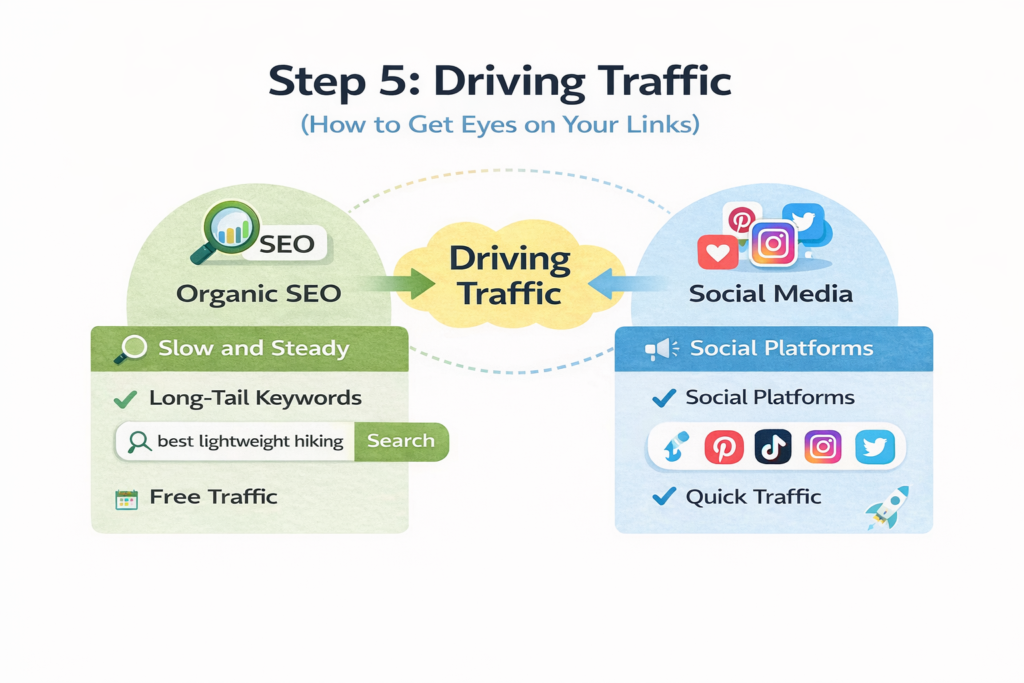
Traffic is the lifeblood of your business. Without visitors, your affiliate links are just empty code. In 2026, the best strategy is a mix of “Slow and Steady” (SEO) and “Fast and Social” (Social Media). By diversifying where your visitors come from, you protect your business from sudden platform changes or algorithm updates.
1. Organic SEO (The Long Game)
Focus on “Long-Tail Keywords.” These are specific phrases like “best lightweight hiking boots for narrow feet.” While fewer people search for these, the people who do are highly motivated to buy. SEO takes 6-12 months to kick in, but once it does, it provides “free” traffic 24/7.
2. Social Media (The Conversation Starter)
Use platforms like Pinterest, TikTok, or Instagram to “seed” your content. These platforms are great for catching people’s attention with quick tips or visual inspiration. The goal is to drive that social traffic back to your blog or email list where you can convert them into buyers and long-term fans.
Final Thoughts: Your Future Self is Waiting
Affiliate marketing in 2026 is a beautiful, complex, and incredibly rewarding journey. It’s not just about links and revenue; it’s about helping people make better decisions in a world overwhelmed by choices. You are the curator, the tester, and the guide for your audience. In this time period affiliate marketing for beginner is lot more easier if they use other social media platforms to promote there links.
I will not say it is get rich quick scheme but it require your time and long term efforts, and if you dedicate your self or 6 to 12 month in it results will show up, starting any new business is the hardest part but as you keep going in the process will start getting easier and I guarantee you this, but in starting of 3 to 4 months its will look like its not working but eventually you will start seeing traffic, clicks, and most important commission.
I want you to take a deep breath. You don’t need to be an expert to start; you just need to be one step ahead of the person you are helping. Every “pro” was once a beginner who felt overwhelmed by the technical terms and the sheer amount of work required.
Your Action Plan:
- Today: Pick your micro-niche based on what you already love.
- Tomorrow: Set up your basic WordPress site or YouTube channel.
- Next Week: Write your first “Honest Review” and share it with the world.
The internet is a big place, and there is more than enough room for your unique voice. Stop watching others make a living online and start building your own path today. Your future self will look back at this moment as the day everything changed.