
I spent two weeks going through niche site case studies, keyword research threads, and income reports from bloggers who document their process publicly. The pattern I kept seeing was the same: the people who got traction fastest weren’t in the biggest niches. They were in specific, overlooked corners where the competition was thin and the buyers were real.
Here’s what I found.
What are low competition niches for affiliate marketing?
A low competition affiliate niche is a specific topic where the pages currently ranking on Google have weak authority, thin content, or both — meaning a new site can rank faster without needing years of backlinks. Low competition does not mean low profit. It means you’re competing where you can actually win instead of fighting sites with decade-old domains and millions of backlinks.
What Actually Makes a Niche “Low Competition”?
Most beginners pick broad niches — fitness, finance, tech — and then wonder why nothing ranks after six months. It’s not the content. It’s the competition.
A low competition niche is one where the top-ranking pages have Domain Authority under 30, articles under 1,500 words, and almost no backlinks — which means a newer site with genuinely better content can outrank them.
Think about the difference between “best protein powder” and “best vegan protein powder for women over 50 with IBS.” Same broad topic. Completely different competition. The first is owned by Healthline and Bodybuilding.com. The second has thin Amazon pages and outdated blog posts ranking — and the person searching it is very close to buying.

Low volume does not mean low income. A niche with 400 monthly searches and weak competition will consistently earn more than a niche with 40,000 searches where you can’t get past page three.
High Competition vs. Low Competition — Side by Side
| POINTS | High Competition | Low Competition |
|---|---|---|
| Example keyword | “Best running shoes” | “Best running shoes for flat feet women” |
| Who’s ranking | Nike, Runner’s World, Wirecutter | Small blogs, thin Amazon listicles |
| Domain Authority | 60–90+ | Under 30 |
| Time to rank | 2–4 years minimum | 6–12 months with consistent content |
| Buyer intent | Mixed — browsing and buying | High — very specific search, close to purchase |
How Do You Find a Low Competition Niche That’s Actually Profitable?
The whole process takes a few hours — not days. And you don’t need a single paid tool to do it.
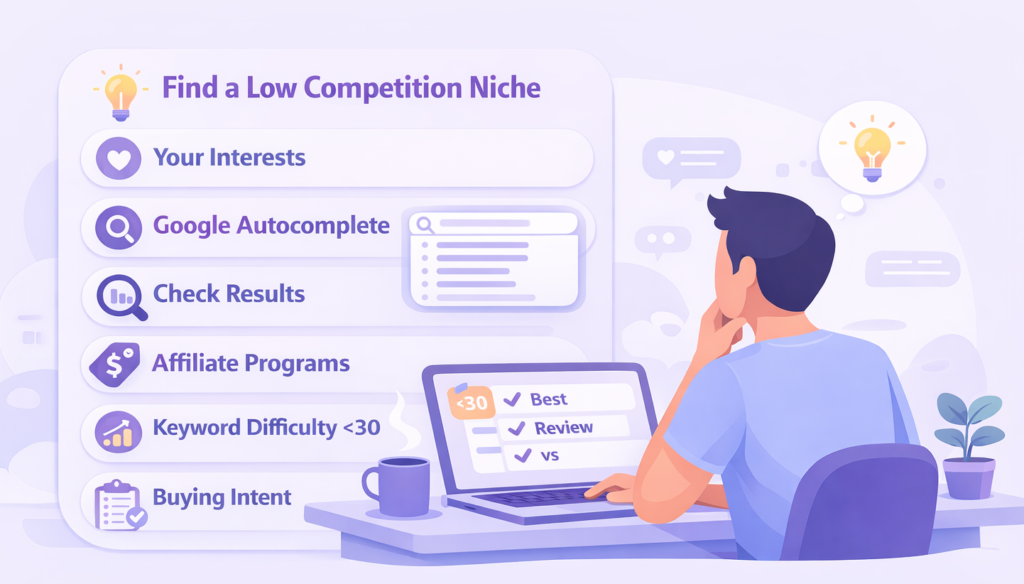
- Pick a broad topic you could write about consistently for months without running out of ideas. Not what pays the most on paper — something you’d actually research on your own.
- Open Google and type your topic + “for” — the autocomplete results are real searches real people make. “Yoga for…” gives you “yoga for seniors,” “yoga for back pain,” “yoga for beginners at home.” Write everything down.
- Search each sub-topic and look at page one. Forbes, Healthline, or Wirecutter showing up? Move on immediately. Small personal blogs, thin content, basic Amazon pages? That’s your green light.
- Find at least three affiliate programs with 15%+ commission or recurring payouts. No programs means no income no matter how well you rank — verify this before you fall in love with the idea.
- Check buyer intent. Keywords with “best,” “review,” “vs,” or “for [specific person]” mean someone close to a purchase. Keywords starting with “what is” or “how does” mean someone still learning. You want the first group.
- Check keyword difficulty using Ubersuggest’s free tier or Google’s People Also Ask box. Aim for difficulty scores under 30.
Do all six before committing. A few hours here saves months of writing in the wrong direction.
Which Low Competition Niches Are Actually Worth Targeting in 2026?
These aren’t random suggestions. Each one has documented affiliate programs, real buyer intent, and weak existing content I verified through research.
Ergonomic Gear for Remote Workers
The remote work shift created a permanent, growing audience searching for desk setups, posture tools, and eye strain solutions. Most existing content is either generic tech roundups or thin Amazon listicles with no real depth. FlexiSpot, Autonomous, and dozens of productivity SaaS tools all run affiliate programs paying 10–20% — and the content gap is still wide open.
Personal Finance Tools for Freelancers
Standard personal finance content is written for salaried employees. Freelancers have completely different problems — irregular income, self-employment tax, invoice management, quarterly payments. That gap is wide open.
FreshBooks, QuickBooks Self-Employed, and AND.CO all have affiliate programs, and the audience has high purchase intent because they’re looking for solutions to real, ongoing financial pain. This is probably the most underserved angle in the personal finance space right now.
Pet Products for Specific Breeds
“Dog toys” is impossible to rank for. “Interactive puzzle toys for French Bulldogs with breathing issues” is not.
Breed-specific content attracts passionate, loyal audiences who spend heavily and trust specific recommendations over generic roundups. Chewy’s affiliate program plus direct programs from niche pet brands cover this well, and the content competing in these sub-niches is genuinely thin.
Budget Homesteading and Self-Sufficiency
There’s a large beginner audience searching for small-scale composting, seed saving, and basic food preservation — and most existing content is either aimed at experienced homesteaders or too surface-level to be useful.
Amazon Associates covers the equipment side well, and specialty stores like True Leaf Market run direct programs with better commission rates than you’d find through a network.
Accessibility and Adaptive Products
Gardening tools for arthritis, weighted blankets for specific weight ranges, adaptive kitchen equipment — this audience searches with extremely high intent and almost no good resources exist for them.
ShareASale and Commission Junction both have relevant merchants here. I’d honestly say this is the most underserved of the six — the content gap is real and the buyer intent is as high as it gets.
Digital Tools for Small Creators
Not “best video editing software” — that’s too broad and too competitive. But “best video editing software for educators creating course content” or “best design tools for Etsy sellers under $20/month” — specific, underserved, and full of SaaS tools with 20–40% recurring commissions that compound over time.

What Mistakes Kill Most Beginner Niche Choices?
When I was going through niche research case studies, I kept seeing beginners make the same four mistakes — and honestly, every single one is avoidable if you catch it before you start writing.
Picking a Niche With Nothing to Sell
You could rank #1 for “how to fix a squeaky door.” But there’s no affiliate program for door hinges, and if there were, the commission would be cents.
Always verify monetization before you write a single word. Find three affiliate programs with real commission rates before you commit. If you can’t find them in 20 minutes, the niche isn’t ready.
Going So Specific There’s No Audience Left
Specific is good. Invisible is not.
“Best yoga mats for left-handed people over 65 with knee problems” — there’s nobody searching that. If most of your target keywords get under 100 monthly searches, the audience is too small to build on. Narrow your niche, but verify real people are actually searching before you commit.
Choosing What You Love Without Checking Who You’re Fighting
I’d honestly say this wastes more time than any other mistake. You find a topic you’re genuinely excited about, plan out 30 post ideas — then realise the entire first page of Google is DR 80 sites that have been publishing for ten years.
Interest matters. But always check the competition before you commit, not after.
Quitting After Five Articles
This is the one that kills more niche sites than anything else.
Spencer Haws from Niche Pursuits has documented multiple niche sites across different timelines — the consistent finding is that topical authority starts signalling to Google around the 15–25 post mark, not the 5-post mark. Five posts and stopping isn’t failure — it’s stopping right before things start moving.
If your niche research was solid and your content is genuinely useful, the problem is almost never the niche. It’s the timeline.
FAQ
How do I know if a niche has low enough competition?
Search your main keywords and look at the top 10 results. Check Domain Authority using Moz’s free checker or Ubersuggest. If most ranking pages have DA under 30, articles under 1,500 words, and few backlinks — that’s beatable for a new site with better content.
Can you make real money from niches with small search volumes?
Yes — and often more than from high-volume niches. The person searching “best composting bin for a small apartment balcony” is far more likely to buy than someone searching “composting tips.” Low volume with high buyer intent beats high volume with mixed intent almost every time.
How many articles before I start seeing traffic?
Spencer Haws from Niche Pursuits documents this consistently across his sites — meaningful organic traffic typically starts showing up between months 4 and 8, with 15–25 published posts. Fewer posts means Google hasn’t seen enough topical depth to treat your site as an authority yet.
Do I need to be an expert in the niche I pick?
No. You need to be willing to research it more thoroughly than the average person and be honest about what you know versus what you found. The researcher framing — “I went through case studies and here’s what the data shows” — works in any niche and is more credible than fake expertise.
What’s the clearest sign a niche is too competitive?
First page is all DR 60+ sites with 3,000+ word guides and thousands of backlinks. If that’s what you’re seeing on your main keywords, the niche is too competitive for a new site right now. Go one level more specific — find the sub-angle those big sites are ignoring.
Where Do You Actually Start?
Pick one broad topic. Run it through Google autocomplete, find three or four specific sub-niches, check the competition on each, verify the affiliate programs exist.
Then commit to 20 posts before deciding whether it’s working.
I’d honestly start with what you already know something about — not what looks most profitable on paper. The niche you can keep researching and writing about for a year is worth more than the niche with the highest commission rate that you’ll abandon after eight posts.
The niche isn’t usually what breaks a beginner affiliate site. Stopping too early is.
If you’re still figuring out where to actually start — read this complete guide on Affiliate Marketing for Beginner before you set anything up.