
I’ll be honest with you.
When I started researching affiliate marketing, the question how to find right niche for affiliate marketing completely stumped me. Everyone said “follow your passion.” But what if your passion is watching crime documentaries at midnight? That’s not exactly a niche.
So I spent weeks going through income reports, Reddit threads, and beginner case studies. I wanted to understand what actually works — not what sounds good.
And I kept seeing the same pattern. Over and over.
Finding the right niche is not magic. It’s a simple process. And once you understand it, the confusion goes away pretty fast.
This post walks you through that process step by step.
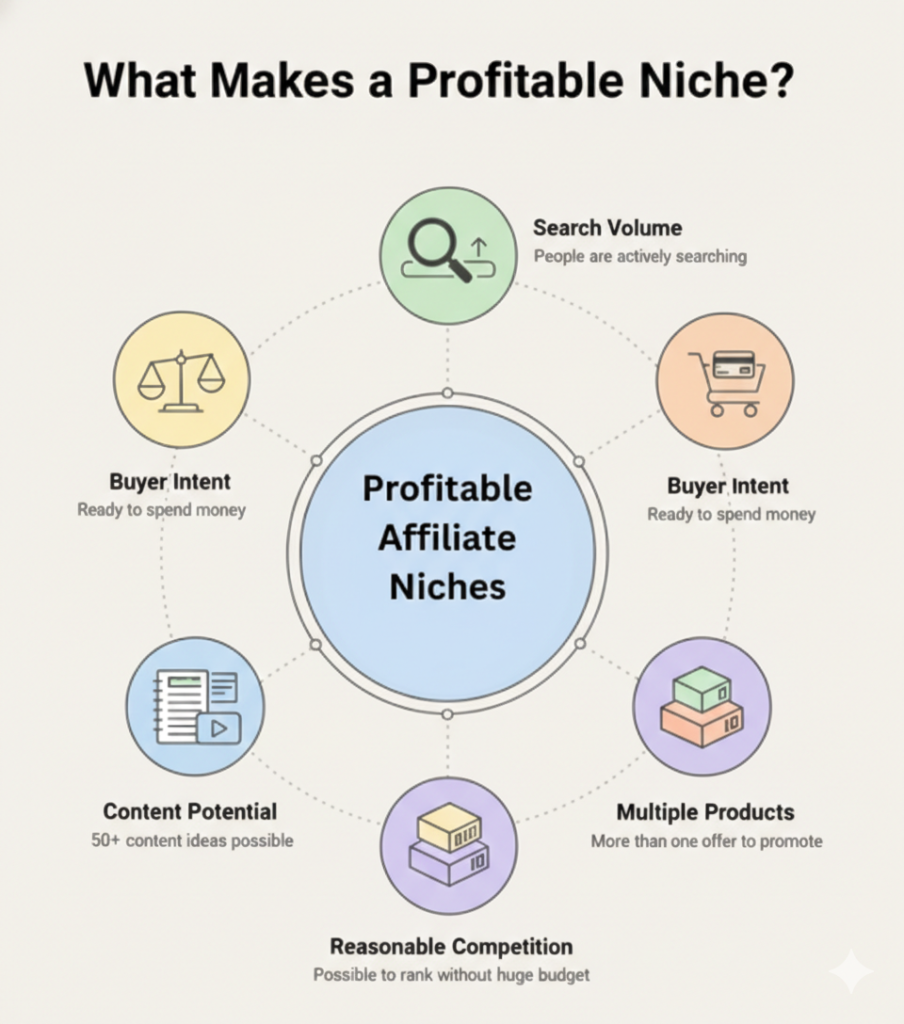
What is the right niche for affiliate marketing? The right affiliate niche is a specific topic where people actively search for solutions and are willing to pay for them. It should have real products to promote, multiple affiliate programs, and low-to-medium competition that a new blogger can realistically enter.
What does “niche” mean in affiliate marketing — and why does it matter?
If this word still feels confusing, don’t worry. It confused me too.
A niche is just a specific topic you focus your whole blog on. Not “fitness.” Not “money.” Something like “home workouts for busy moms” or “budgeting for college students.”
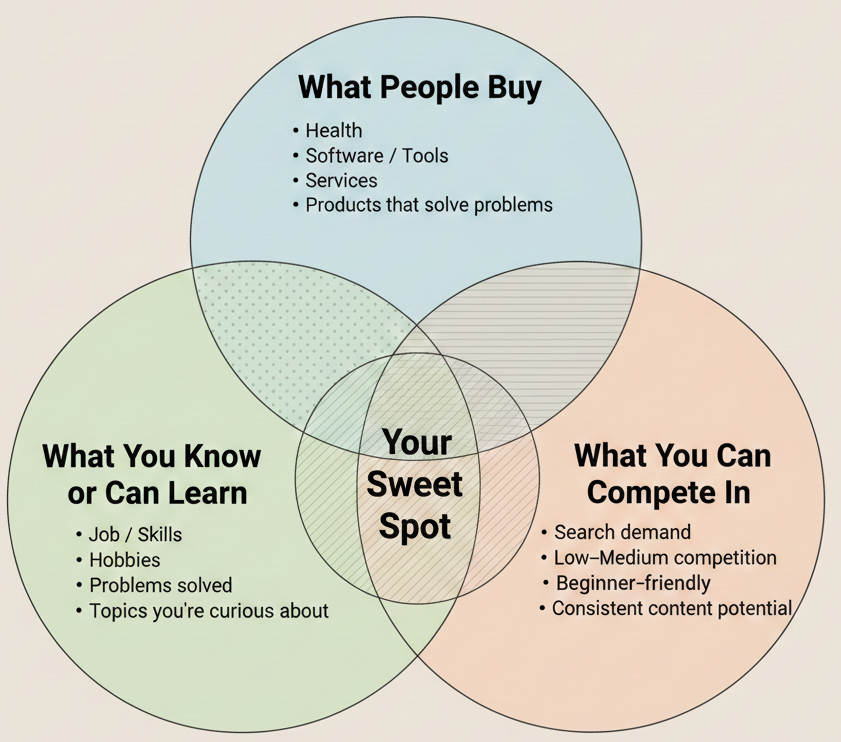
The more specific you are, the easier it is to reach the right people.
Think about it like this. If you search “best running shoes” — you’re competing with Nike, Healthline, and Runner’s World. But “best running shoes for flat-footed beginners under $100”? A small blog actually has a chance there.
That’s what a niche does. It gives you a real fighting chance.
Why do so many beginners pick the wrong niche?
I went through a lot of beginner stories while putting this together. One pattern kept coming up.
People pick a niche based on what they love. Without checking if anyone is actually spending money there. Three months later, they have 20 posts and basically zero traffic.
That’s not a writing problem. That’s a niche problem.
I came across one story on Reddit. A guy spent four months building a site around a hobby he was genuinely passionate about. Turned out, people in that community mostly swapped tips for free. Nobody was buying anything online. Four months of work. Zero income.
So passion alone is not enough. You need passion plus demand plus real products to promote. All three together.
How do you find a profitable affiliate niche in 3 steps?
While researching, I kept seeing the same approach come up in success stories. Here it is broken into 3 steps.
Step 1 — Check if people are searching for it
Go to Google. Type “best [product] for [problem].” See what shows up.
If affiliate blogs are in the top results, that’s a good sign. It means someone is already earning money in that niche.
Then use a free keyword tool. Ubersuggest and Google Keyword Planner both work. Look for search volumes between 1,000 and 10,000 per month on your main keywords.
Below 1,000 means very little traffic. Above 10,000 usually means very tough competition for a new site.
Step 2 — Check if people are buying
Go to Amazon. Search for products in your niche idea. If products have hundreds or thousands of reviews — people are actively buying. That’s the signal you need.
Then search “[your niche] + affiliate program” on Google. If you find 5 to 10 programs with reasonable commissions, you’re in good shape. If you find almost nothing — move on.
Step 3 — Check if you can actually compete
Search your main keyword. Look at the top 10 results.
Ask yourself: is this content actually helpful? Is it recent? Does it answer what a beginner needs to know?
If the top posts are old or missing key details — that’s your opening. You don’t need to beat the big sites on everything. You just need to cover the angles they’ve ignored.
This is something that’s very doable in 2026. A lot of older blog posts were written for a different search landscape. Many haven’t been updated in years. If you write better, more current content on a specific topic — Google notices.
Check out this blog to get complete guide on affiliate marketing
What makes a good niche vs. a bad niche — side by side
| POINTS | Good niche | Bad niche |
|---|---|---|
| Search demand | 1,000–10,000 monthly searches | Under 200 or over 100,000 |
| Buyer intent | People spend money to solve this problem | People just browse for free |
| Affiliate programs | 5–10+ programs available | 0–1 programs or very low commissions |
| Competition | Mix of small and medium sites ranking | Only massive authority sites ranking |
| Content potential | You can write 50+ posts | You run out of ideas within 10–15 posts |
| Trend stability | Consistent year-round demand | Seasonal spike or dying trend |
| Example | “Meal prep for people with diabetes” | “Fidget spinners for adults” |
How do you find problems people actually pay to solve?
People don’t buy products. They buy a solution to something that’s bothering them.
So instead of thinking “what can I promote,” think “what problem am I helping someone fix?”
Some problems that consistently lead to purchases:
- Health: back pain, poor sleep, weight loss, skin care
- Career: skills, certifications, productivity tools
- Money: getting out of debt, saving, earning on the side
- Parenting and relationships: communication, guidance, confidence
- Pets: training, food, health care
The best way to find these problems is to go where people complain.
Read Reddit threads in your niche. Read the one-star Amazon reviews. Browse Facebook groups. Look at questions on Quora.
When you see the same frustration showing up again and again — that’s a real problem. And real problems lead to real purchases.
Which niche categories work in 2026?
Here are some starting points. You’ll still need to narrow each one down into something specific.
Health and fitness — not just “fitness.” Something like “low-impact workouts for people with knee pain” or “meal planning for beginners who don’t like cooking.”
Personal finance — not just “saving money.” Something like “how to stop living paycheck to paycheck” or “investing basics for people who are scared to start.”
Home and garden — “indoor plants that are hard to kill” or “small apartment organization on a tight budget.”
Tech and software — “best free tools for freelancers” or “how to edit videos on your phone for YouTube.”
Pet care — dog training, cat health, fish tanks. Pet owners spend a lot and search constantly.
Hobbies with gear — photography, camping, cooking, crafts. People in these spaces buy equipment regularly.
Pat Flynn from Smart Passive Income talked about this years ago. One of his early niche sites — Security Guard Training HQ — was hyper-specific. That site alone earned him over $100,000. The whole strategy was just being specific.
That approach still works today.
The pattern is always the same. “Fitness” is a category. “Yoga for beginners with back pain” is a niche.
What are the warning signs of a niche that won’t work?
No products to promote. If you can’t find at least 5 affiliate programs, the niche probably won’t support a whole blog.
Very cheap products. Promoting a $4 item might earn you $0.20 per sale. You’d need thousands of sales to make a few hundred dollars. Not worth the effort.
One-time purchases only. Mattresses, wedding dresses — people buy once and don’t come back.
Pure entertainment topics. Movie reviews, gaming news, celebrity gossip — people come to read, not to buy.
Trends that are dying. Fidget spinners were everywhere for a moment. That moment ended fast. Sites built on trends don’t have a long future.
How long does it actually take to earn money?
This is a question a lot of beginners have. And I think it deserves a straight answer.
I went through public income reports from bloggers who documented their journey. Here’s what the realistic picture looks like based on those reports:
Months 1–3 — You’re setting things up. Writing posts. Figuring out SEO. Most people earn nothing here. That’s completely normal.
Months 4–6 — Content starts getting indexed. Some traffic comes in. Some people see their first $50 or $100. Many still see nothing. Both are normal.
Months 7–12 — With consistent work, traffic usually grows. Some bloggers report $200–$500 per month around this stage.
Year 2 and beyond — This is where things start to add up. Bloggers who stayed consistent report $1,000–$5,000+ per month.
I’m sharing these numbers from what bloggers documented publicly. Your results will depend on your niche, your content, and how consistently you publish.
The thing I keep seeing in every success story though? The people who made it simply didn’t stop early. I hope you have got a little clarity on how to find right niche for affiliate marketing.
Frequently asked questions about finding an affiliate niche
Do I need to be an expert in my niche?
No. You just need to research properly before you write. Readers can tell when someone did their homework.
What if my niche feels too competitive?
Go narrower. “Weight loss” is too big. “Weight loss for people who hate the gym” is something you can work with.
Can I run two niches at once?
You can. But when you’re starting out, one niche is hard enough. Split focus usually slows both down.
How do I know which affiliate programs to join?
Start with Amazon Associates. It’s easy to join and covers almost every product. Then look for niche-specific programs on ShareASale or CJ Affiliate.
What if I pick the wrong niche?
You’ll usually know within 60 to 90 days. Check your search data. Is anyone finding your posts? Are they clicking links? If nothing is moving, it might be time to rethink. And yes — you can switch niches. It costs time, but it’s not the end of the road.
Is it too late to start a niche blog in 2026?
No. New bloggers are still finding their footing in niches every year. The ones who do well pick a specific topic and stay consistent for longer than most people are willing to.
So where do you actually start?
Think about where your interest, real buyer demand, and realistic competition all meet.
Check if people are searching for it. Check if they’re buying. Check if your content can actually get seen.
Then pick one thing and start.
Most people stay stuck in the research phase because starting feels scary. The research feels safe. But a blog you never start will never earn anything.
Pick a niche. Take the first step. And if it doesn’t work out, you’ll have learned more in 90 days than you ever would from just reading about it.